

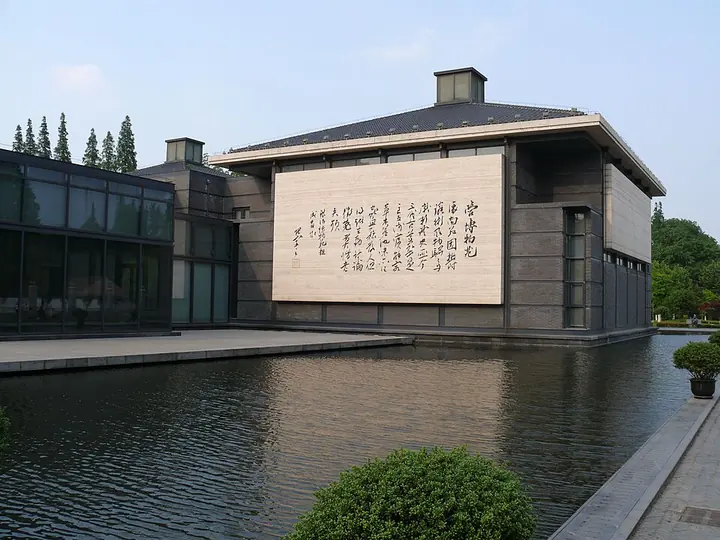
Photo adjustments
Full frame retained; proportionally resized and converted to WebP. No retouching or changes to the photographed subject. Card displays may crop the view.
Explore the region
About Nantong Museum
Founded by Zhang Jian, it presents both local history and natural-history material.
Chinese-style and Western-style buildings provide an architectural contrast before entering the galleries. Neolithic objects, pottery and calligraphy connect with local culture, while natural specimens include a whale skeleton. Select the current galleries for these themes rather than relying on an older building-by-building display plan.
Zhang Jian (张謇) conceived the museum after visiting Japan in 1903 to study industry and education; his 1905 petition to the Qing government to build one in the capital was not adopted, so he built one himself in Nantong instead. He had already set aside land west of Tongzhou Normal School (通州师范学校), across the Haohe river (濠河), for a public botanical garden in 1904, and decided the next year to develop a museum from it; construction was largely finished by 1911.
Originally attached to Tongzhou Normal School and doubling as a botanical and zoological garden, the institution took the name Nantong Museum Garden after 1912. Japanese forces occupied Nantong in March 1938 and used the site as an army headquarters, looting or destroying most of the collection. It was restored under municipal management from 1951, merged into the Jiangsu Provincial Museum in 1954, and recovered its original name in 1984, becoming one of China's first national first-class museums in 2008.
The South Hall (南馆), a brick-and-timber building in a slightly Western style, was built in 1906 as the museum's main exhibition hall, with an arched porch and flanking pavilions displaying ancient statues. Surviving early garden features include the Tengdong waterside pavilion (藤东水榭), the Guoxiu altar (国秀坛), and a rockery and pond.
What to look for
- Chinese-style and Western-style historic buildings form a garden museum ensemble.
- Natural-history specimens, including a whale skeleton, contrast with local archaeological collections.
Background & history
Nantong Museum (Chinese: 南通博物苑; pinyin: Nántōng Bówùyuàn) is located in Nantong, Jiangsu Province, China, at 19 Qixiu Road in Chongchuan District. It is near the center of the city, beside the Haohe river. It was established by a well-known educator, Zhang Jian in 1905. It is made of five parts, the center, the south, the north, the east, and the west. It is one of the oldest museums in China.
Excerpt from Wikipedia: Nantong Museum · Wikipedia contributors · CC BY-SA 4.0. Selected introductory sentences; formatting simplified. Background information, not current visitor-service advice.
Location & getting there
Getting to Nantong Museum
Approach 19 Qixiu Road in Chongchuan, beside the Haohe River in central Nantong.
Combine your visit
A suggested sequence linking the specific features of this visit.
-
Historic museum buildings and garden
Begin with the contrasting architectural forms.
-
Local-history collections
Explore the archaeology and cultural objects associated with Nantong.
-
Natural-history displays
Compare the human-history material with the specimen collections.
This order is editorial. Confirm access and any transfers between stops; it does not establish a walking route, same-day connection or common admission ticket.
Find Nantong Museum
南通博物苑 · 南通市
The pin marks the area, not the entrance.
More places nearby
Approximate straight-line distances between map pins, not travel distances.
Nantong Textile Museum 南通纺织博物馆
1 km awayNantong Textile Museum examines the links between cotton cultivation, hand weaving and the city’s later textile factories. The main galleries compare traditional tools and products with the development of machine production in…
View guide →Langshan (Nantong) 狼山
6 km awayLangshan, or Wolf Hill, stands in southern Nantong near the Yangtze. It belongs to a group of five hills that form a distinct landscape at the river’s lower reaches.
View guide →Haohe River Scenic and Historic Spot 濠河风景名胜区
33 km awayThe Haohe follows the moat around Nantong’s old city, creating a water circuit lined with gardens and cultural landmarks. Wenfeng Pagoda and Nantong Museum provide two contrasting stops: a vertical religious landmark and Zhang…
View guide →Sources & visit information
The sources below support the place-specific description and arrival information. Suggested combinations are editorial planning ideas; confirm current opening, entry arrangements and transport services for your date.
Visitor information adapted and edited from Wikipedia contributors, “Nantong Museum” · CC BY-SA 4.0. Source revision 1363296773.
Visitor information adapted and edited from Wikivoyage contributors, listing “Nantong Museum” · CC BY-SA 4.0.
Background paragraphs translated and condensed from Wikipedia contributors, "南通博物苑", Chinese Wikipedia · CC BY-SA 4.0. Source revision 94275630.