

Photo adjustments
Full frame retained; proportionally resized and converted to WebP. No retouching or changes to the photographed subject. Card displays may crop the view.
Explore the region
About Ming Imperial Tombs (Fengyang)
They lie south of the county town, separate from the imperial mausoleums near Nanjing and Beijing.
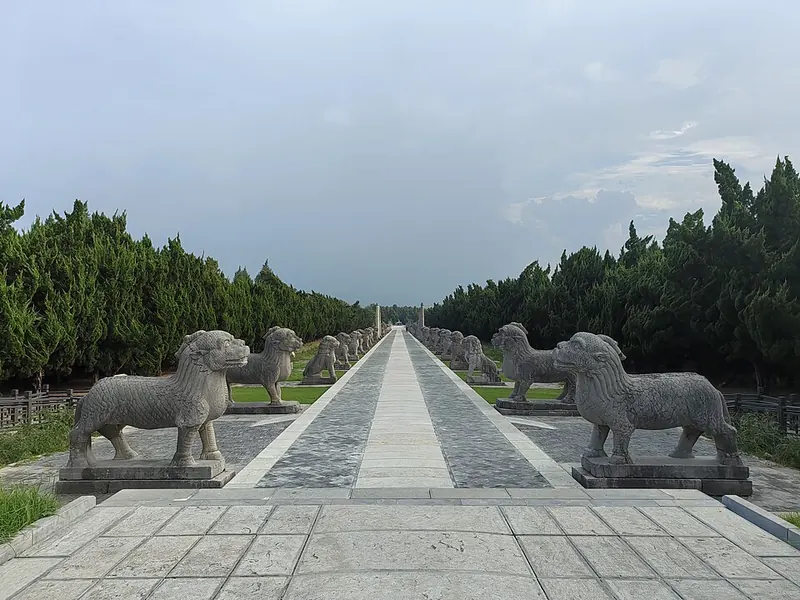
The Great Ming Imperial Tomb stele is an important record of the founding emperor’s family history. The complex was damaged in the Cultural Revolution and subsequently repaired, which is part of the context for reading the surviving monuments.
The tombs were built for Zhu Yuanzhang's (朱元璋) father, Zhu Shizhen (朱世珍), titled Chun Huangdi (淳皇帝), and his mother, titled Chun Huanghou (淳皇后). Construction ran from the twelfth year of Longfeng (龙凤), in 1366, to the twelfth year of Hongwu (洪武), in 1379. Repairs began in 1982 following damage to the stelae, stone human and horse figures, and imperial enclosure during the Cultural Revolution. The State Council of the People's Republic of China (中华人民共和国国务院) listed the complex as a Major Historical and Cultural Site Protected at the National Level (全国重点文物保护单位).
What to look for
- The Great Ming Imperial Tomb stele records the founding emperor’s family background.
- The surviving funerary monuments belong to a mausoleum built for Zhu Yuanzhang’s parents.
Location & getting there
Getting to Ming Imperial Tombs (Fengyang)
Approach the imperial tomb precinct south of Fengyang county town. Keep the parents’ mausoleum separate from references to Zhu Yuanzhang’s own tomb in Nanjing.
- Confirm the visitor entrance and access to the named areas before departure.
Combine your visit
A suggested sequence through the named features described in the source.
-
Tomb stele
The Great Ming Imperial Tomb stele records the founding emperor’s family background.
-
Funerary monument precinct
The surviving funerary monuments belong to a mausoleum built for Zhu Yuanzhang’s parents.
The order is an editorial suggestion. Internal opening arrangements and transfers between sectors need checking; no walking duration or access entitlement is implied.
Find Ming Imperial Tombs (Fengyang)
明皇陵 · 滁州市
The pin marks the area, not the entrance.
More places nearby
Approximate straight-line distances between map pins, not travel distances.
Shuangdun site 双墩遗址
27 km awayShuangdun is a Neolithic terrace site in Shuangdun village, north of the Huai River at Bengbu. Its archaeological remains date back more than seven millennia.
View guide →Shou County 寿县
74 km awayShouxian’s old walled centre preserves a compact view of the region’s urban history. The city walls and moat give the settlement its outline, while Bao’en Temple, the Confucian temple and mosque reveal different religious…
View guide →Shou County City Wall 寿县古城墙
74 km awayShou County’s city wall preserves a complete sense of an enclosed historic town. Its four gates are Binyang, Tongfei, Dinghu and Jinghuai, and their barbicans remain important parts of the defensive layout.
View guide →Sources & visit information
The linked encyclopedia sources support background and place descriptions. Current opening hours, ticket prices, booking rules and transport schedules have not been independently verified for this guide. Confirm them with the venue or operator before travelling.
Visitor information adapted and edited from Wikipedia contributors, “明皇陵” · CC BY-SA 4.0. Source revision 93901545.
Background paragraphs translated and condensed from Wikipedia contributors, "明皇陵", Chinese Wikipedia · CC BY-SA 4.0. Source revision 93901545.