

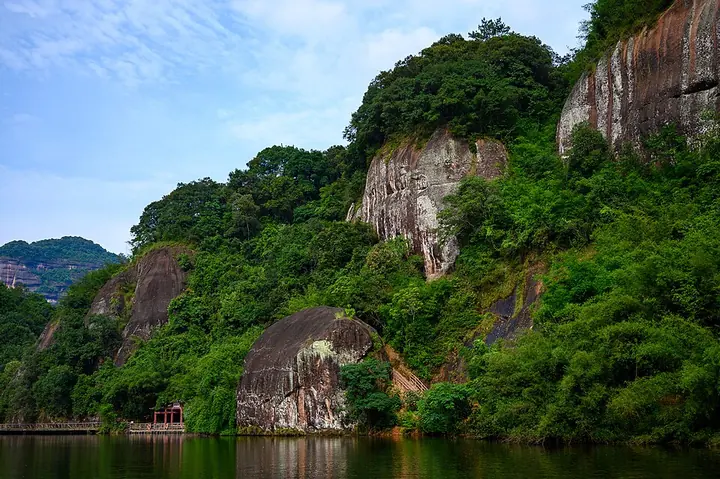
Photo adjustments
Full frame retained; proportionally resized and converted to WebP. No retouching or changes to the photographed subject. Card displays may crop the view.
Explore the region
About Danxia Mountain
Erosion has separated the rock into towers and distinctive formations, including Yangyuan Stone, while paths and temple sites occupy ledges and higher ground. Choose one principal walking area and leave time to study the layered rock faces. River sightseeing is a separate way to understand the terrain, but neither boats nor steep hill routes should be assumed available in every weather condition.
The name Danxia Shan dates to 820, when the Chan monk Tianran (天然禅师) saw the mountain's rock 'as vivid as vermilion, bright as morning cloud' and renamed it accordingly, founding Danxia Temple (丹霞寺). In the late Ming and early Qing the loyalist Li Yongmao (李永茂) and his family took refuge here, buying the mountain from local scholars and cutting gates, stone steps and ladders into the cliffs. In 1928 the geologist Feng Jinglan (冯景兰) named its red sandstone beds the 'Danxia strata,' a term later adopted as 'Danxia landform.'
Structural uplift after the late Cretaceous raised the red-bed basin in intermittent stages, producing dense vertical joints in the rock. Rainwater then cut downward along these joints, widening them into steep-walled gullies and gorges that separate the mountain's red sandstone into towers and cliffs.
Danxia Mountain is a national nature reserve, a national key scenic area and a national geopark, and was named one of the first UNESCO Global Geoparks on 13 February 2004. In 2010 it was inscribed on the World Heritage List as part of the joint 'China Danxia' nomination with five other Danxia landform sites, becoming Guangdong's only World Natural Heritage property. Its cliff inscriptions (摩崖石刻) were listed among the seventh batch of Major Historical and Cultural Sites Protected at the National Level in 2013.
What to look for
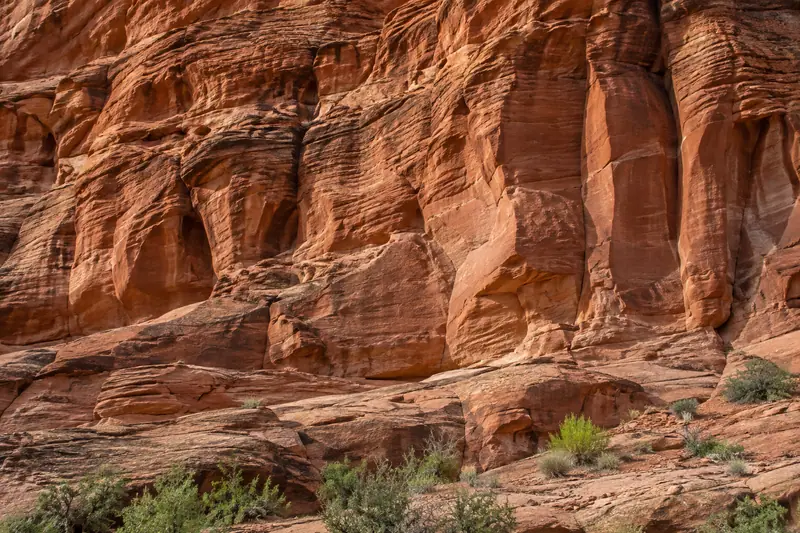
- Red, layered sandstone forms sheer cliffs and isolated rock towers.
- Yangyuan Stone is a distinctive freestanding formation in its own visitor area.
Location & getting there
Getting to Danxia Mountain
Travel to the Danxia Mountain scenic entrance in Renhua County from Shaoguan or Shaoguan East railway station using a current scenic-area connection or an arranged car. The regional guide identifies both stations as departure points; confirm the day’s service and which internal area you intend to visit.
Combine your visit
Suggested order for the visit:
-
Scenic entrance and route map
Select a manageable principal area.
-
Yangyuan Stone area
Examine the isolated formation and surrounding cliffs.
-
River-viewing section
Add a permitted waterside viewpoint or operating boat service.
This is an editorial sequence of named spaces or places. It does not imply a verified walking connection or promise opening, ticket availability or a journey time.
Find Danxia Mountain
丹霞山 · 韶关市
The pin marks the area, not the entrance.
More places nearby
Approximate straight-line distances between map pins, not travel distances.
Shaoguan Museum 韶关市博物馆
32 km awayShaoguan Museum is particularly useful for seeing everyday activities represented in ancient pottery. Its regional collections include brown-glazed models of ploughing and working rice fields, with small human figures and oxen…
View guide →Nanhua Temple 南华寺
44 km awayNanhua Temple is a Chan Buddhist monastery at Maba in Shaoguan’s Qujiang district. It is closely associated with Huineng, the Sixth Patriarch of Chan Buddhism, who lived and taught here. That connection makes the temple a…
View guide →Lianzhou Underground River 连州地下河
144 km awayLianzhou Underground River combines a walking cave with a boat passage beneath the hills. The upper two levels contain dry galleries with stalactites and other limestone formations, while the lowest level carries the…
View guide →Sources & visit information
The sources below support the place-specific description and arrival information. Suggested combinations are editorial planning ideas; confirm current opening, entry arrangements and transport services for your date.
- Mount Danxia ↗
- Wikivoyage: Shaoguan ↗
- Danxia Mountain management authority ↗
- Chinese Wikipedia: 丹霞山 (revision 94064538, 2026-08-27) ↗
- English Wikipedia: Mount Danxia (revision 1369555103, 2026-08-15) ↗
Visitor information adapted and edited from Wikipedia contributors, “Mount Danxia” · CC BY-SA 4.0. Source revision 1369555103.
Visitor information adapted and edited from Wikivoyage contributors, Shaoguan · CC BY-SA 4.0. Source revision 5309445.
Background paragraphs translated and condensed from Wikipedia contributors, "丹霞山", Chinese Wikipedia · CC BY-SA 4.0. Source revision 94064538.
Background paragraphs condensed from Wikipedia contributors, "Mount Danxia", English Wikipedia · CC BY-SA 4.0. Source revision 1369555103.