

Entry & permits for Tibet (Xizang)
Foreign tourists need Tibet entry approval, commonly called a Tibet Travel Permit, and an organised visit arranged through a specialist travel agency in China. Confirm your approved route before booking transport. Requirements differ for Taiwan residents and for travellers using mainland or Hong Kong/Macao Chinese resident documents; check the document guide before you book.
Check the travel-document requirements →Policy scope verified: 2026-09-06. UK FCDO: China regional travel advice ↗ State Council Taiwan Affairs Office: Tibet entry approval ↗ Xizang Department of Culture and Tourism: Medog border permit notice ↗
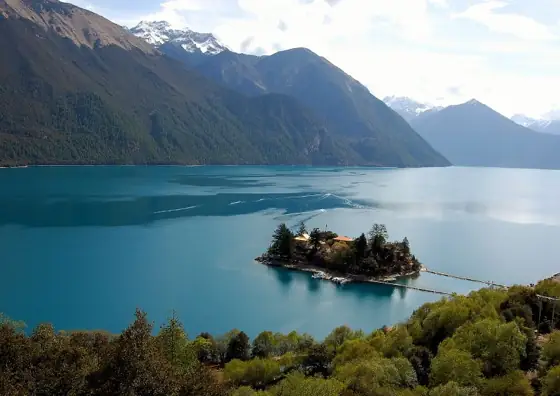
Photo adjustments
Resized and WebP compressed; subject not altered.
City & district guides
About Basum Tso
The small Tashi Island near the southwestern shore holds Tsodzong Monastery, giving the lake a distinct religious focus. A visit can alternate between this compact island setting, the open water and the surrounding village landscape. Nearby Jieba adds a view of settled life beside the lake. Keep these accessible shore areas as the core visit; the more distant Xin Tso extension needs its own planning.
The lake fills a U-shaped trough carved by the Zhala Longba Glacier (扎拉弄巴冰川) and Zhongcuo Longba Glacier (锺错弄巴冰川), where a terminal moraine blocked the valley in the upper reaches of the Ba River (巴河). It has a crescent-shaped outline, with a surface elevation of about 3,480 metres. Its east-west length is 13.8 kilometres, and its average north-south width is 1.85 kilometres.
Tashi Island (扎西岛) holds the Nyingma monastery Tsodzong (措宗寺), whose Tibetan name means 'castle in the lake'. One account traces its foundation to the Tubo (吐蕃) period, though most surviving buildings date to a mid-fourteenth-century rebuilding led by the monk Sangye Lingpa (桑杰林巴). Wooden carvings at its entrance are associated with fertility worship. The lake has nature-scenery category 5A scenic-area status.
What to look for
- Tashi Island and Tsodzong Monastery near the southwestern shore.
- The forested lake basin and the village setting around Jieba.
The surrounding area
Eastern valleys, lakes and canyon scenery around Basum Tso and the Yarlung Zangbo.
Location & getting there
Getting to Basum Tso
The established road approach runs from Bahe town towards Basum Tso in Gongbo’gyamda County.
- Begin at the scenic-area visitor arrival point and confirm local transport to the island and village stops.
Combine your visit
Suggested order for this visit:
-
Tashi Island
Start with the monastery and the compact island landscape.
-
Main lakeshore viewpoints
Read the surrounding forested glacial valley.
-
Jieba village
Add the nearby village setting as a separate local transfer.
This is an editorial sequence based on the features described in the sources. Confirm access locally; no walking time, shared admission or guaranteed interior access is implied.
Find Basum Tso
巴松措 · 林芝
The pin marks the area, not the entrance.
More places nearby
Approximate straight-line distances between map pins, not travel distances.
Xiuba Ancient Towers秀巴古堡
30 km awayFive surviving stone towers rise from Xiuba village near Bahe, with traces of walls and other buildings around them. Their faceted construction is unusually distinctive: the outside has twelve sides and ridges, while the hollow…
View guide →Kading Valley Wishing Pond卡定沟许愿池
35 km awayThe Wishing Pond is a named stop within Kading Gorge, a forested valley near the Niyang River west of Bayi. The broader visit is defined by Tianfo Waterfall and Qianfo Cliff, whose natural rock shapes are interpreted as Buddhist…
View guide →Nyingchi林芝
57 km awayNyingchi's urban base at Bayi opens onto the Niyang valley, where forested hills and river scenery replace the bare plateau landscape many visitors associate with Tibet. A coherent westward outing follows the G318 corridor to…
View guide →Sources & visit information
The sources below support the place-specific description and arrival information. Suggested combinations are editorial planning ideas; confirm current opening, entry arrangements and transport services for your date.
- Wikipedia: 巴松措 ↗
- Nyingchi tourism authority: Bahe–Basum Tso approach ↗
- Gongbo’gyamda tourism authority account: Jieba village beside Basum Tso ↗
Visitor information adapted and edited from Wikipedia contributors · CC BY-SA 4.0. Source revision 93197602.
Background paragraphs translated and condensed from Wikipedia contributors, "巴松措", Chinese Wikipedia · CC BY-SA 4.0. Source revision 93197602.