

Entry & permits for Tibet (Xizang)
Foreign tourists need Tibet entry approval, commonly called a Tibet Travel Permit, and an organised visit arranged through a specialist travel agency in China. Confirm your approved route before booking transport. Requirements differ for Taiwan residents and for travellers using mainland or Hong Kong/Macao Chinese resident documents; check the document guide before you book.
Check the travel-document requirements →Policy scope verified: 2026-09-06. UK FCDO: China regional travel advice ↗ State Council Taiwan Affairs Office: Tibet entry approval ↗ Xizang Department of Culture and Tourism: Medog border permit notice ↗
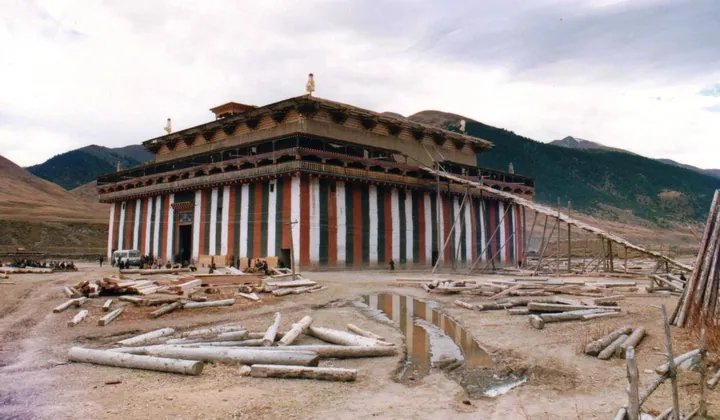
Photo adjustments
Full frame retained; proportionally resized and converted to WebP. No retouching or changes to the photographed subject. Card displays may crop the view.
City & district guides
About Riwoche Monastery
Its lower walls carry striking red, white and black vertical stripes, while the upper red and white storeys step inward beneath a golden roof. The building combines Tibetan, Chinese and Nepalese craft traditions. Inside, large columns, images and thangkas create a dense devotional setting associated with the Taklung Kagyu lineage. The exterior colour pattern alone makes this a distinctive visit before any permitted interior viewing.
Sangye On (桑吉温) founded the monastery in 1277 on the Nayi Tang plain (纳衣塘), beside the upper Se Qu River (色曲河), and became its first abbot. The monastery developed the 'Lower Taklung' branch, alongside the 'Upper Taklung' tradition at Taklung Monastery (达隆寺). It was destroyed during the Cultural Revolution, restored on its original site in 1982 and reconsecrated on the fourth day of the sixth Tibetan month that year. Further major repairs followed in 1986.
Chajema Hall (查杰玛) became a Major Historical and Cultural Site Protected at the National Level (全国重点文物保护单位) in 2006. Its holdings include more than 1,000 Buddhist statues, over 300 thangkas and numerous scriptures, with more than a hundred objects classified as national first- or second-grade cultural relics. Murals on two walls of the second-storey Red Hall (红殿) depict successive Kagyu teachers and eminent monks.
What to look for
- Chajema’s striped lower walls and receding red-and-white upper storeys.
- The great columned hall, with its Buddhist images and thangkas where viewing is permitted.
Location & getting there
Getting to Riwoche Monastery
Use Riwoche/Leiwuqi Monastery in Leiwuqi town, on the Nayi Tang plain in the upper Sechu valley.
- Specify the monastery town and Chajema hall, rather than assuming the county’s administrative centre is the same destination.
Combine your visit
Suggested order for this visit:
-
Chajema exterior
Begin with the distinctive stripes and tiered massing.
-
Open main-hall route
Study the columns, images and thangka tradition.
-
Outer prayer-wheel circuit
Complete a short exterior sequence around the hall, respecting worshippers.
This is an editorial sequence based on the features described in the sources. Confirm access locally; no walking time, shared admission or guaranteed interior access is implied.
Find Riwoche Monastery
类乌齐寺 · 昌都
The pin marks the area, not the entrance.
More places nearby
Approximate straight-line distances between map pins, not travel distances.
Galden Jampaling Monastery强巴林寺
69 km awayGalden Jampaling stands on the terraces of Mala Hill above central Chamdo, where the city developed around converging rivers. The monastery’s name refers to Maitreya, and its main assembly hall is surrounded by colleges, chapels…
View guide →Karuo Archaeological Site卡若遗址
76 km awayKaruo preserves the evidence of a prehistoric settlement in the upper Lancang valley. Excavations revealed house foundations, stone and bone tools, pottery and traces of millet cultivation and pig keeping. The changing house…
View guide →Sources & visit information
The linked encyclopedia sources support background and place descriptions. Current opening hours, ticket prices, booking rules and transport schedules have not been independently verified for this guide. Confirm them with the venue or operator before travelling.
Visitor information adapted and edited from Wikipedia contributors · CC BY-SA 4.0. Source revision 93287107.
Background paragraphs translated and condensed from Wikipedia contributors, "类乌齐寺", Chinese Wikipedia · CC BY-SA 4.0. Source revision 93287107.
Background paragraphs condensed from Wikipedia contributors, "Riwoche Monastery", English Wikipedia · CC BY-SA 4.0. Source revision 1367129455.