

Photo adjustments
EXIF orientation normalized; resized without changing aspect ratio; converted to WebP. No subject edits.
Explore the region
About Jiyi Temple
Jiyi Temple (稷益庙), known locally as Yangwang Temple (阳王庙), is a Ming-dynasty temple to the legendary ancestors Houji (后稷) and Boyi (伯益) in the centre of Yangwang village (阳王村), Yangwang town (阳王镇), about 15 kilometres southwest of the seat of Xinjiang County (新绛县), Yuncheng (运城), Shanxi.
The temple faces south on a roughly square plot about 89.6 metres from north to south and 40 metres across, laid out as a single courtyard. Only three parts survive: the opera stage, the foundations of the offering hall and the main hall; everything else has been pulled down. No one knows when it was founded. According to the Xinjiang county heritage protection centre, steles record repairs in the Zhiyuan era of the Yuan dynasty and enlargements under the Ming Hongzhi and Zhengde emperors. The main hall was rebuilt in 1502, though parts of its roof frame keep Yuan-period methods, and the temple was repaired again in 1984. The State Council listed it among the fifth batch of Major Historical and Cultural Sites Protected at the National Level on 25 June 2001.
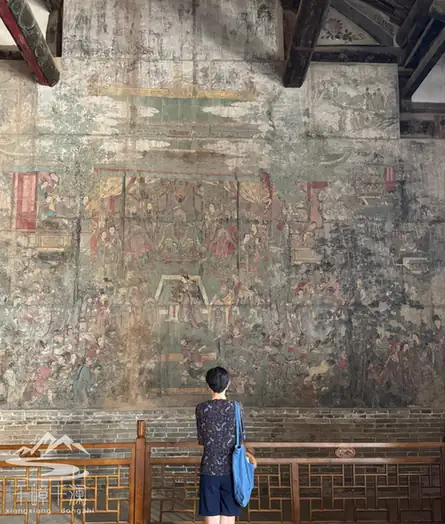
The main hall holds the temple's murals. Five bays wide under a single-eaved overhanging gable roof finished with glazed tiles, it is painted on its east, west and south walls with a mural the county heritage centre calls a 'Pilgrimage Scene' (朝圣图) and puts at 153.91 square metres. Drawn from myth and legend, it shows ancestral figures, among them Yu the Great, Houji, Boyi and the Three Sovereigns, taming nature and helping the people while officials, commoners and deities come to pay homage; Chinese Wikipedia counts more than 400 figures. An inscription high on the south wall dates the work to 1507, and Chinese Wikipedia names seven painters from Yicheng (翼城) and Jiangzhou (绛州), among them Cheng Ru (程儒). The statues that once stood in the hall were destroyed during the Cultural Revolution. The Ming opera stage also survives, five bays wide and likewise under an overhanging gable roof.
What to look for
- The 1507 murals on the east, west and south walls of the main hall
- The painters' inscription of 1507 high on the south wall
- Scenes of Yu the Great, Houji, Boyi and the Three Sovereigns receiving homage
- The main hall of 1502, with glazed tiles and an overhanging gable roof
- The Ming-dynasty opera stage
- The foundations of the former offering hall
Location & getting there
Getting to Jiyi Temple
- Search for 稷益庙 with 运城市 and 新绛县.
Find Jiyi Temple
稷益庙 · 新绛县
No reliable map pin yet: search by the Chinese name.
Sources & visit information
Written from the linked sources and checked sentence by sentence against quoted extracts by a separate reviewer on 2026-09-23. Opening hours, admission and access arrangements are not covered; confirm current visitor information with the site.
Some facts checked against Wikipedia contributors, "稷益庙" · CC BY-SA 4.0.