

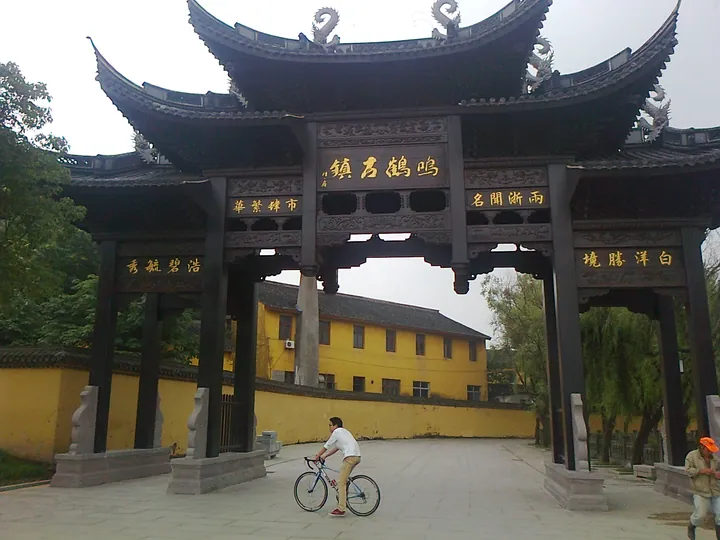
Photo adjustments
Full frame retained; proportionally resized and converted to WebP. No retouching or changes to the photographed subject. Card displays may crop the view.
Explore the region
About Minghe Ancient Town
Minghe Ancient Town (鸣鹤古镇) is an old town in the south of Guanhaiwei (观海卫镇), Cixi (慈溪), Ningbo (宁波), set between Du Lake (杜湖) and Baiyang Lake (白洋湖) below Mount Wulei (五磊山). Ningbo Daily reports that it was named a China Historical and Cultural Town in 2019.
The town's streets run along the foot of the hills and its houses back onto the waterways. Ningbo Daily puts the core area at 0.5 km², with the Wulei Mountain scenic area to the east and the Shanglin Lake (上林湖) provincial scenic area to the west. Chinese Wikipedia divides the land into hills of the Cuiping range (翠屏山), an outlier of the Siming Mountains (四明山), and a corner of the Ningshao Plain. A local saying holds that 'the scenery of Hegao rivals Suzhou' (鹤皋风景赛姑苏).
Minghe dates from the Kaiyuan reign of the Tang, more than 1,200 years ago. It takes its name from Yu Jiugao (虞九皋), a grandson of Yu Shinan (虞世南). Yu Jiugao's courtesy name was Minghe; he died in Chang'an soon after passing the jinshi examination, and local people named his home village after him. In the Xianping reign of the Northern Song the salt-producing town became a salt-buying station, and Chinese Wikipedia says local salt output peaked in the Song and Yuan at three-tenths of Zhejiang's total. Groups of Yue ware kiln sites survive at Li Du Lake (里杜湖) and Baiyang Lake, no fewer than ten sites in all.
From the Ming and Qing most townsmen left to trade, above all in Chinese medicine. Ningbo Daily counts more than 150 century-old firms founded or largely run by Minghe people, among them Ye Tongren Tang (叶同仁堂) in Wenzhou and Hu Qing Yu Tang (胡庆余堂) in Hangzhou. In the Republican years the town was a market for cotton, rice and white cloth. In 2001 Minghe town merged with Guancheng (观城) and Shiqiao (师桥) to form the new town of Guanhaiwei.
Six Cixi city-level protected sites stand around Du Lake, and horse-head gable walls survive in Yinhao Lane (银号弄). Minghe is also known for its rice cakes (年糕): at the first Minghe Rice Cake Festival in December 2020, makers showed each stage of washing the rice, grinding it, firing the stove, steaming and pounding, and China Daily describes the result as chewy and springy. The town's Biqi-variety bayberries (荸荠种杨梅) are sold in Shanghai, Hangzhou and Ningbo.
What to look for
- The old streets and lanes along the river, including the horse-head gables of Yinhao Lane (银号弄)
- Du Lake (杜湖), ringed by six Cixi city-level protected sites
- Baiyang Lake (白洋湖) on the town's southwest side, with a group of Yue kiln sites
- Wulei Mountain scenic area (五磊山风景区): Wulei Temple (五磊讲寺), a lotus garden and the Cangyun Stream (藏云溪)
- Site of the founding of the Communist Party's Eastern Zhejiang Committee (中共浙东区委成立旧址), with horse-head gable walls
- Minghe rice cakes, made by the traditional pounding method
Location & getting there
Getting to Minghe Ancient Town
- Search for 鸣鹤古镇 with 宁波市 and 慈溪市.
Find Minghe Ancient Town
鸣鹤古镇 · 慈溪市
No reliable map pin yet: search by the Chinese name.
Sources & visit information
Written from the linked sources and checked sentence by sentence against quoted extracts by a separate reviewer on 2026-09-23. Opening hours, admission and access arrangements are not covered; confirm current visitor information with the site.
Some facts checked against Wikipedia contributors, "鸣鹤镇" · CC BY-SA 4.0.