

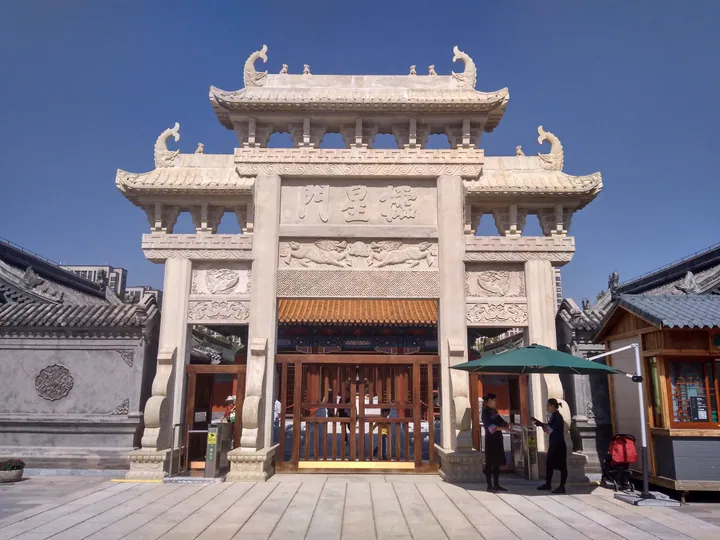
Photo adjustments
Full frame retained; proportionally resized and converted to WebP. No retouching or changes to the photographed subject. Card displays may crop the view.
Explore the region
About Jimo Ancient City
The district government describes the plan on the formula of one city, two streets, ten scenes and thirteen wards: a wall with three gates encloses the quarter, and East and West Menli Street run right across it. The buildings are in grey brick with dark tiles and the lanes are lined with shops. Scattered among them are the school hall, the Confucian temple, memorial archways, the Wanzihui building, the county yamen, a City God folk-customs museum, a Zhenwu folk-customs museum, the city wall itself and a Christian church. Hotels, bookshops, food and entertainment operate alongside these, and the quarter was approved in the first national group of night-time culture and tourism consumption clusters.
The Confucian temple shows how the reconstruction works. The original stood 224 metres east of the town's central crossroads on the north side of Zhongshan Street, on a site of about 3,000 square metres, and was founded in 1270 by two local brothers, Lü Zan and Lü Gui, who traded their own fields for the land and gave 500 strings of cash towards the halls. It was repaired and enlarged repeatedly; in 1714 Guo Xiu erected two stone archways outside the gate with dismounting steles beside them. On 22 January 1898 more than three hundred German soldiers occupied Jimo and made the temple their headquarters, damaging the statue of Confucius and gouging out the eyes of the statue of the worthy Zhongzi before leaving in March. The Jimo juren Huang Xianggu and 103 other examination candidates petitioned the throne, Kang Youwei then gathered more than two thousand candidates behind the protest, and the episode is remembered as the second gongche shangshu petition. Troops of Sun Dianying burned the Dacheng Hall in June 1929. The present temple was rebuilt from the diagram in the Tongzhi-era Jimo County Gazetteer, with three courtyards along an axis of Lingxing Gate, Pan Pool, Dacheng Gate, Dacheng Hall and Chongsheng Shrine.
What to look for
- The rebuilt Confucian temple, with the Lingxing Gate, Pan Pool, Dacheng Gate, Dacheng Hall and Chongsheng Shrine ranged along three courtyards
- The imperially composed stele in praise of Confucius, made in 1686 under the Kangxi emperor, standing east of the path in front of the Dacheng Hall
- The county yamen and the school hall, the two administrative and educational buildings of the old county seat
- The City God and Zhenwu folk-customs museums, housed in the rebuilt temples of those cults
- The wall with its three gates and the memorial archways along East and West Menli Street
Location & getting there
Getting to Jimo Ancient City
Identify the main visitor approach and any separately managed houses, museums or performances. Ask before entering residential spaces or photographing residents.
- Search for 即墨古城 with 青岛市 and 即墨区.

Find Jimo Ancient City
即墨古城 · 即墨区
No reliable map pin yet: search by the Chinese name.
Sources & visit information
The linked sources support the identity and background described in this introduction. Opening hours, admission, activity availability and exact arrival arrangements have not been comprehensively checked. Confirm current visitor information with the venue; the original catalogue locality and editorial review flag are retained.