

Photo adjustments
EXIF orientation normalized; resized without changing aspect ratio; converted to WebP. No subject edits.
Explore the region
About Linzi Ancient Chariot Museum
The pit came to light in 1990, when Shandong provincial archaeologists working ahead of the Jinan to Qingdao expressway were excavating the Houli culture site. The chariot-and-horse burial they found was named one of China's ten major archaeological discoveries of that year. A preparatory office was set up in April 1993 and the museum opened on 9 September 1994, at a cost of more than ten million yuan, on a site of 36,000 square metres with 3,600 square metres of buildings. The chariots and horses remain in the ground where they were buried, and the museum presents them alongside a display of reconstructed vehicles.
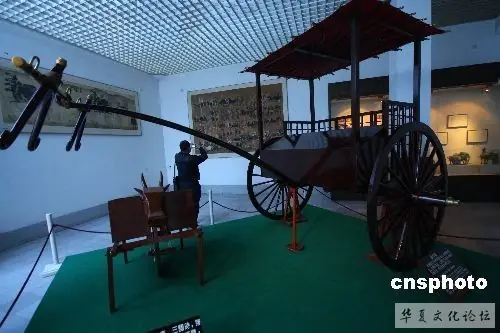
The gallery display holds nineteen full-size reconstructions of different periods and close to a hundred models, together with vehicle and harness fittings, excavated objects and painted copies. The sequence opens with a Shang curved-yoke chariot rebuilt from finds at Guojiazhuang in the Yinxu site at Anyang, then a Western Zhou two-horse chariot and a four-horse Spring and Autumn war chariot reconstructed from the Houli burial itself. The second gallery starts with a Warring States war chariot based on finds from the Tian Qi royal tombs at Linzi, short in the shaft and narrow in the track, and goes on to a Qin vehicle copied from bronze chariot number two at the First Emperor's mausoleum and to Han examples. The third covers later centuries, from a long-awning ox cart of the Wei, Jin and Northern and Southern dynasties to a Tang ceremonial carriage and a tall Liao camel cart. The museum stands just north of the Tian Qi royal tombs, the Jishan scenic area and the Guan Zhong Memorial.
What to look for
- The Spring and Autumn chariot-and-horse pit, kept in the ground with the real vehicles and animals as they were buried
- The four-horse Spring and Autumn war chariot reconstructed from the Houli burial
- The Shang curved-yoke chariot rebuilt from the Guojiazhuang finds at the Yinxu site in Anyang
- The Warring States war chariot based on finds from the Tian Qi royal tombs at Linzi, with its short shaft and narrow track
- The Western Jin pottery horse with a pair of stirrups, shown as evidence for the early Chinese stirrup, and the Tang ceremonial lu carriage
Location & getting there
Getting to Linzi Ancient Chariot Museum
Confirm the venue or campus, reservation channel and exhibition calendar. A museum name may cover more than one building.
- Search for 临淄古车博物馆 with 淄博市 and 临淄区.
Find Linzi Ancient Chariot Museum
临淄古车博物馆 · 临淄区
No reliable map pin yet: search by the Chinese name.
Sources & visit information
The linked sources support the identity and background described in this introduction. Opening hours, admission, activity availability and exact arrival arrangements have not been comprehensively checked. Confirm current visitor information with the venue; the original catalogue locality and editorial review flag are retained.