

Photo adjustments
Full frame retained; proportionally resized and converted to WebP. No retouching or changes to the photographed subject. Card displays may crop the view.
Explore the region
About Mount Yi
Mount Yi (峄山) is a 582 m granite mountain of piled boulders 10 km south of the urban area of Zoucheng (邹城), Shandong.
The Zoucheng city publicity office dates the mountain's formation to about 2.5 billion years ago and names its signature scenery a "stone-egg landform" (石蛋地貌): huge rounded granite boulders stacked into piles, stone forests and oddly shaped fallen rocks, and caves linked one to another. Local tradition counts thirty-six grotto-heavens and seventy-two sights. The mountain is a national AAAA tourist attraction, a provincial scenic area, a national forest park and a provincial geopark.
In ancient times it was called Dong Shan (东山), the "Eastern Mountain" of the Mencius (孟子) line saying that Confucius climbed it and found the state of Lu small; a spot called Xiaolu Terrace (小鲁台), "Lu-looks-small terrace", preserves the story. In 219 BC the First Emperor of Qin (秦始皇) climbed Mount Yi on his tour of the east, and his chancellor Li Si (李斯) wrote an inscription praising his deeds, known as the Qin Yishan Stele (秦峄山碑). Du Fu (杜甫) later wrote that the stele had been burned in a wildfire and that recarvings on jujube-wood blocks had grown fat and lost the original's likeness; Su Dongpo (苏东坡) answered him in verse. Daoist schools and Buddhist monks also practised on the mountain, and the ruins of the Zhu state capital (邾国故城) lie on its south side.
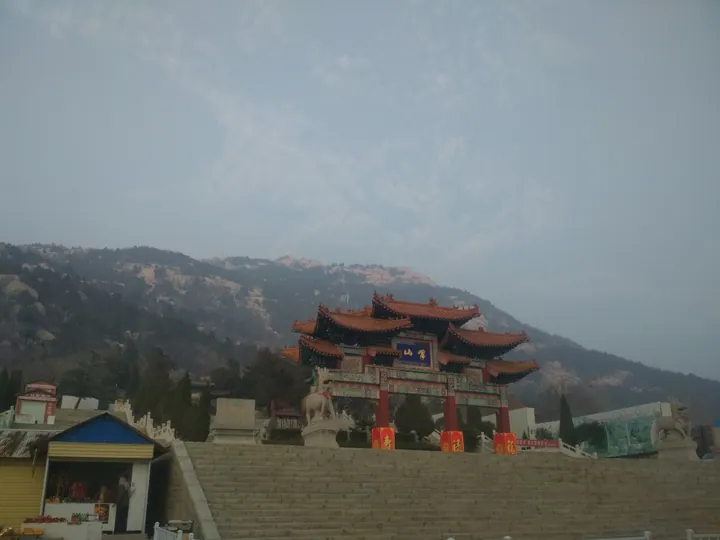
The climb from the south starts at a tall new memorial archway carrying the characters "峄山" (Mount Yi) written by the calligrapher Sha Menghai (沙孟海), then passes the First Gate, known as Youhe Gate (有赫门), rebuilt on the site of a Yuan-dynasty gate. Taiping Xingguo Temple (太平兴国寺), counted first of the mountain's twelve "blessed places", was founded in 1008. Carvings of the Manjusri Prajnaparamita Sutra (文殊般若经) survive on Wuhua Peak (五华峰), the main summit, and beside Yaojing Cave (妖精洞); the latter, dated to 573 in the Northern Qi from an inscription in its corner, is a Shandong provincial protected site. A temple fair on the second day of the second lunar month runs for three days.
What to look for
- The granite "stone-egg" boulder piles, stone forests and linked caves
- Wuhua Peak, the main summit, with a sutra carving of which 72 of its 98 characters remain
- Sutra carving beside Yaojing Cave (妖精洞), dated 573 and listed as a Shandong provincial protected site
- Xiaolu Terrace (小鲁台), linked to Confucius's climb of the Eastern Mountain
- Taiping Xingguo Temple (太平兴国寺), founded in 1008 and rebuilt in 1463, 1586 and 1655
- Yiyang Academy (峄阳书院), rebuilt in 2010 on the site of an academy founded in the Qianlong reign
- The Mount Yi archway inscribed by Sha Menghai and the rebuilt Youhe Gate (有赫门)
Location & getting there
Getting to Mount Yi
- Search for 峄山 with 济宁市 and 邹城市.
Find Mount Yi
峄山 · 邹城市
No reliable map pin yet: search by the Chinese name.
Sources & visit information
Written from the linked sources and checked sentence by sentence against quoted extracts by a separate reviewer on 2026-09-23. Opening hours, admission and access arrangements are not covered; confirm current visitor information with the site.
Some facts checked against Wikipedia contributors, "峄山" · CC BY-SA 4.0.