

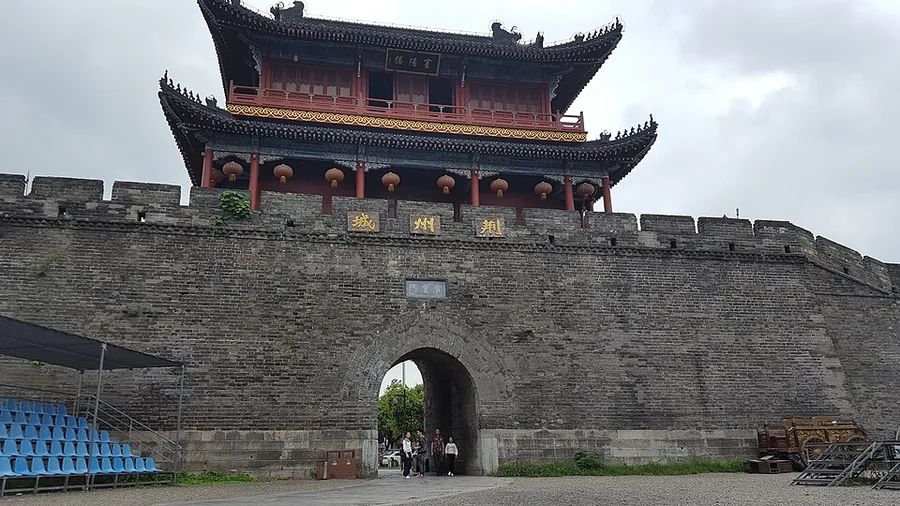
Photo adjustments
Full source framing retained; proportionally resized and converted to WebP. No retouching or subject alteration. Card displays may crop the view.
Explore the region
About Jingzhou Ancient City
Jingzhou Ancient City (荆州古城) is the walled old town of Jingzhou (荆州) in Hubei's Jingzhou District (荆州区), on the southwest edge of the Jianghan Plain (江汉平原) and the north bank of the Jingjiang (荆江) stretch of the Yangtze. It is enclosed by a brick wall rebuilt in 1646 on Ming foundations.
The wall grew in layers. After a rainstorm brought down its southeast corner in 1997, archaeologists dug through Song and Five Dynasties brick walls into earthen ramparts of the Jin and Three Kingdoms periods. The oldest core is a rammed-earth wall from the reign of Emperor Jing of the Western Han (西汉景帝); Gao Jixing (高季兴), ruler of Nanping (南平) in the Five Dynasties, later added a brick wall over it. Guan Yu (关羽) is among those recorded as repairing it. Kublai Khan had it pulled down in 1276, and Zhang Xianzhong (张献忠) demolished most of it in 1643. Chutian Metropolis Daily reported in 2005 that the finds show it to be the surviving Chinese city wall with the longest continuous history and the most dynasties behind it, grown from an earth rampart into a brick wall, and that its line moved only about 50 metres over those centuries.
Today's wall forms an irregular rectangle about 3.75 kilometres east to west and 1.2 kilometres north to south, enclosing 4.5 square kilometres. The 1646 rebuilding renamed its six gates: Yinbin Gate (寅宾门) in the east, Gong'an Gate (公安门) in the southeast, Anlan Gate (安澜门) in the west, Nanji Gate (南纪门) in the south, and Gongji Gate (拱极门) and Yuan'an Gate (远安门) as the large and small north gates. Three more three-arched gates were cut after 1970. Defences include barbicans and troop chambers with loopholes for archers, and a 200-metre section west of the small north gate, built in the Ming Chenghua era, is made of lime and sticky rice mortar.
Hubei listed the town as a provincial protected site in 1956, and the wall became a national key cultural relics protection unit in 1996. In 1982 the State Council named Jingzhou one of China's first 24 historical and cultural cities. The wall entered China's World Heritage tentative list in 2007 alongside those of Nanjing, Xi'an and Xingcheng, and the Jingzhou government describes it as part of the joint World Heritage bid for Ming and Qing city walls. A tree-lined road runs between the wall and the moat, where residents walk the circuit of more than 11 kilometres.
What to look for
- Chaozong Tower (朝宗楼) over Gongji Gate (拱极门), the large north gate
- Binyang Tower (宾阳楼) over Yinbin Gate (寅宾门), the east gate
- Nanji Gate (南纪门), the south gate
- The City Wall Archaeological Site Exhibition Hall (荆州城墙考古遗址展示馆)
- Troop chambers (藏兵洞) and barbicans built into the wall
- The Ming Chenghua-era lime and sticky rice wall section west of the small north gate
- The ring road between the wall and the moat, lined with willows and dawn redwoods
Location & getting there
Getting to Jingzhou Ancient City
- Search for 荆州古城 with 荆州市 and 荆州区.

Find Jingzhou Ancient City
荆州古城 · 荆州区
No reliable map pin yet: search by the Chinese name.
Sources & visit information
Written from the linked sources and checked sentence by sentence against quoted extracts by a separate reviewer on 2026-09-23. Opening hours, admission and access arrangements are not covered; confirm current visitor information with the site.
- 以镜头语言展现古城千年文脉与文化魅力 《何以中国·只此城墙》来荆取景-荆州市人民政府网 ↗
- 荆州古城 南方完璧 (Xinhua Hubei, from 楚天都市报, 2005-07-22; Internet Archive copy) ↗
- 荆州城墙 - 维基百科,自由的百科全书 ↗
Some facts checked against Wikipedia contributors, "荆州城墙" · CC BY-SA 4.0.