

Photo adjustments
EXIF orientation normalized; resized without changing aspect ratio; converted to WebP. No subject edits.
Explore the region
About Chengtoushan Neolithic Site
Archaeologists in Lixian came across the site during a cultural relics survey in 1985. The Hunan Provincial Institute of Cultural Relics and Archaeology made a trial excavation in 1992 and has since worked on parts of the site ten times. The occupation belongs to the Daxi, Qujialing and Shijiahe cultures of prehistoric southern China and is dated to roughly 6,500 to 7,000 years ago. A ditch was dug and a wall raised around the settlement in the early Daxi period, about 6,500 years ago; people then lived inside it for more than two thousand years before the town was given up in the middle Shijiahe period, about four thousand years ago. The rampart was repaired repeatedly and enlarged three times on a large scale, which is why so much of it survives. The heritage record published by the Changde Municipal Bureau of Culture, Tourism, Radio, Television and Sports calls Chengtoushan one of the earliest ancient walled-town sites so far discovered in China.
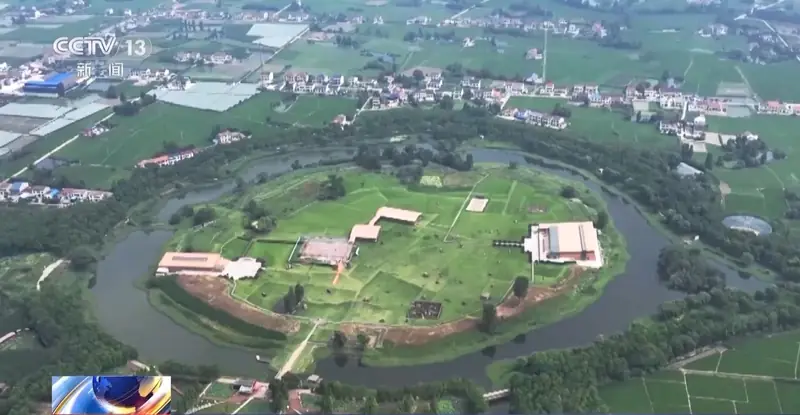
The enclosure is close to circular, 340 m across on the outer line of the wall and 325 m on the inner line, ringed by a moat 35 m wide; the whole site covers almost 150,000 square metres, with more than 80,000 inside the wall. Excavation has exposed platform foundations for houses, a well equipped pottery workshop, a wide street through the settlement, dense and overlapping clan burials, and paddy fields dated to 6,500 years ago that the heritage record describes as the earliest yet preserved anywhere. Cutting through the rampart revealed an earlier Daxi ditch on its outer slope, filled with more than a hundred kinds of animal and plant remains and seeds along with bamboo and reed weaving, boat paddles, stern pieces and planks, and a quantity of mortise-and-tenon timber. Bone spades, ards, drills and chisels, wooden knives, pottery and jade were also recovered. The State Council listed Chengtoushan on 20 November 1996 in the fourth batch of national key cultural relics protection units.
What to look for
- The circular earth rampart, 340 m across on its outer line, and the 35 m wide moat that rings it
- The excavated paddy fields dated to about 6,500 years ago
- Platform foundations of houses and the broad street running through the walled area
- The remains of a pottery workshop found inside the enclosure
- The clan cemetery, a dense and overlapping burial ground within the settlement
Location & getting there
Getting to Chengtoushan Neolithic Site
Check which interiors and courtyards are accessible. Active places of worship and protected monuments may have different visitor rules.
- Search for 城头山 with 常德市 and 澧县.
Find Chengtoushan Neolithic Site
城头山 · 澧县
No reliable map pin yet: search by the Chinese name.
Sources & visit information
The linked sources support the identity and background described in this introduction. Opening hours, admission, activity availability and exact arrival arrangements have not been comprehensively checked. Confirm current visitor information with the venue; the original catalogue locality and editorial review flag are retained.