

Photo adjustments
Full frame retained; proportionally resized and converted to WebP. No retouching or changes to the photographed subject. Card displays may crop the view.
Explore the region
About Mantang Hakka Walled Compound
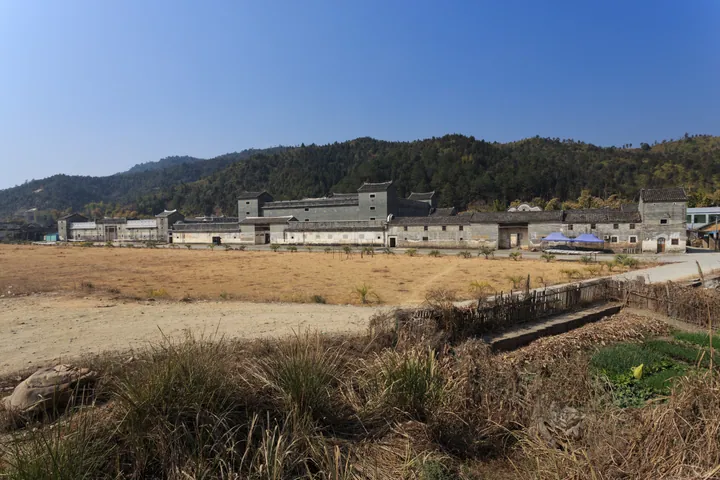
Shixing County is known for this kind of building; local usage has it that every village has a wei and no settlement is complete without one, and at least 500 walled residences of various kinds were built across the county over time. Mantang is the largest of them. Work began in 1833, the thirteenth year of the Daoguang reign, at the direction of a wealthy local landowner named Guan Qianrong, and finished in 1860, twenty-eight years later. The complex falls into three parts, Shangxin Wei, the central Zhongxin Wei and Xiaxin Wei, covering roughly 23,300 square metres of ground with 17,864 square metres of floor area, and containing nine halls, twelve courtyards, twenty-eight light wells and 777 rooms.
The central block is a fortress. It has one entrance only, closed by five successive doors: an iron-faced timber pair, a grid of eleven wooden bars, seven thick vertical boards, a row of eleven cast-iron bars that could be backed with iron plates, and finally a gauze screen against insects. Three narrow holes above the timber doors run up to the floor above so that water could be poured down if attackers tried to burn them. Four storeys high, the block is built of river cobbles at ground level and polished blue brick above, with granite at the corners, blockhouses at each corner of the top floor, and no windows in the outer wall, only granite lookout and firing slits cut wider inside than out. Wall bases beneath the corner towers reach 8.2 metres thick and were built in the 'gold wrapping silver' way, faced with brick and stone around a core of sand and gravel that would spill out and choke any breach. Because the site is a sand bar where two streams meet, the whole building rests on nine layers of pine logs. The complex came to official notice in the first national cultural relics survey of 1983, was listed nationally in 1996, opened to visitors in 2008 and was rated a national AAAA scenic area in 2020.
What to look for
- The five successive doors of the central wei's single entrance, including the iron-bar gate and the fire holes above the timber doors
- The granite lookout and firing slits in the windowless outer wall, cut wider on the inside than the outside
- The corner blockhouses on the top floor of the four-storey central block
- The four-metre-wide covered gallery between the middle and inner layers, its floor laid in river cobbles in seven patterns including peony, lotus, plum and ears of grain
- The named wells inside the complex, among them Yitong Tianxia, Wuzi Dengke and Baizi Qiansun
Location & getting there
Getting to Mantang Hakka Walled Compound
Check which interiors and courtyards are accessible. Active places of worship and protected monuments may have different visitor rules.
- Search for 满堂客家大围 with 韶关市 and 始兴县.
Find Mantang Hakka Walled Compound
满堂客家大围 · 始兴县
No reliable map pin yet: search by the Chinese name.
Sources & visit information
The linked sources support the identity and background described in this introduction. Opening hours, admission, activity availability and exact arrival arrangements have not been comprehensively checked. Confirm current visitor information with the venue; the original catalogue locality and editorial review flag are retained.