

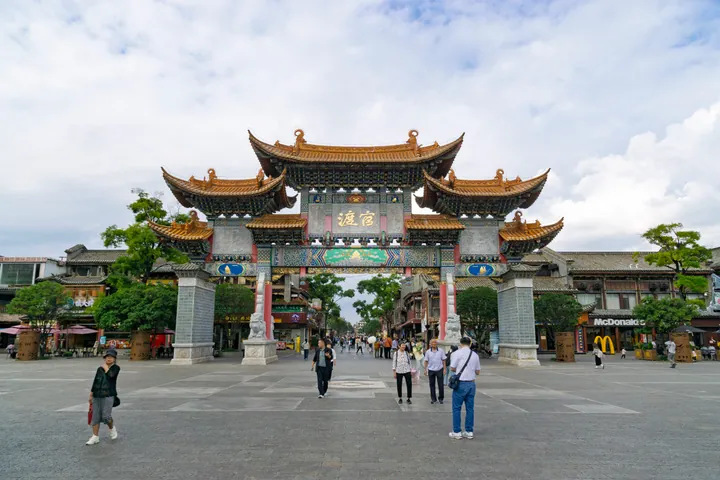
Photo adjustments
Full frame retained; proportionally resized and converted to WebP. No retouching or changes to the photographed subject. Card displays may crop the view.
Explore the region
About Guandu Ancient Town
Guandu Ancient Town (官渡古镇) is an old market town in Guandu District (官渡区), southeast of central Kunming (昆明), near the northeastern shore of Dianchi Lake (滇池) on the lower Baoxiang River (宝象河), about 10 km from the city centre.
The town stands on shells. Archaeologists found a shell mound covering about 10,000 m² and three to eight metres thick, a Neolithic site showing people lived here about 4,000 years ago. The old name, Wodong (蜗洞), and the Yi name Agoulou, "Snail City", both refer to it. In 764 the Nanzhao (南诏) prince Fengjiayi (凤伽异) was sent to build Tuodong City (拓东城) in the Dianchi area; the water then stood higher, travellers crossed from the Western Hills by boat, and a large landing was built at Wodong. The name Guandu, "official ferry", dates from the Song dynasty.
In the early Yuan dynasty the governor Sayyid Ajall (赛典赤·瞻思丁) dredged the rivers feeding Dianchi, the lake shrank and Guandu lost its shoreline. It became instead the road gate from Kunming to southern Yunnan, a trading town in the Ming and Qing. When the Yunnan–Vietnam Railway opened in 1910 it had a station at Xizhuang (西庄), and in the Republican period Guandu was nicknamed "Little Yunnan" (小云南). A first phase of restoration and rebuilding ran from April 2001 to April 2003.
The Guandu District Archives count more than ten protected sites and over a hundred courtyard houses of the "one seal" (一颗印) type, among temples, pavilions and shrines grouped as the "five hills, six temples, seven pavilions and eight shrines". At the centre stands the Vajra Pagoda of Miaozhan Temple (妙湛寺金刚塔), begun in 1457. Around its square are Miaozhan Temple to the north, the Tuzhu Temple (土主庙) to the south, the Sansheng Palace (三圣宫) to the east, and temples to Confucius and Guan Yu to the west. Workshops in the town show two national intangible-heritage crafts: Yunzi Go stones (云子), which visitors can try making, and wutong zouyin (乌铜走银), silver inlaid into blackened copper.
What to look for
- Vajra Pagoda of Miaozhan Temple (妙湛寺金刚塔), a sandstone five-spire pagoda of 1457–58 whose base is pierced by crossing arched passages; a national protected site since 1996
- Han and Tibetan inscriptions set into the pagoda base recording its construction
- Miaozhan Temple (妙湛寺) and the Tuzhu Temple (土主庙) on the pagoda square
- Wenming Pavilion (文明阁) and Kuixing Pavilion (魁星阁), both provincial or municipal protected sites
- "One seal" (一颗印) courtyard houses along the old streets
- The Yunzi Go academy (云子棋院), where visitors can try making Yunzi Go stones
- The wutong zouyin (乌铜走银) workshop showing silver-inlaid black copper ware
Location & getting there
Getting to Guandu Ancient Town
- Search for 官渡古镇 with 昆明市 and 官渡区.
Find Guandu Ancient Town
官渡古镇 · 官渡区
No reliable map pin yet: search by the Chinese name.
Sources & visit information
Written from the linked sources and checked sentence by sentence against quoted extracts by a separate reviewer on 2026-09-23. Opening hours, admission and access arrangements are not covered; confirm current visitor information with the site.
- 跟着档案看云南——昆明篇 |官渡古镇 传统与现代的碰撞和交融_云南档案网 ↗
- 妙湛寺金刚塔 - 维基百科,自由的百科全书 ↗
- 云南昆明:妙湛寺金刚塔-人民图片网 ↗
- 官渡古镇 - 维基百科,自由的百科全书 ↗
Some facts checked against Wikipedia contributors, "妙湛寺金刚塔" · CC BY-SA 4.0.
Some facts checked against Wikipedia contributors, "官渡古镇" · CC BY-SA 4.0.