

Photo adjustments
EXIF orientation normalized; resized without changing aspect ratio; converted to WebP. No subject edits.
Explore the region
About Xinzhai Gyanak Mani Stone City
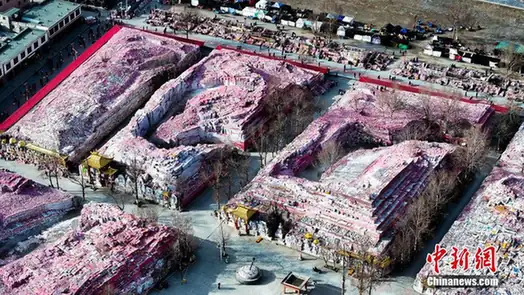
China Daily, reporting from Yushu in 2025, describes the site as the world’s largest mani stone mound and names its founder as 道丹松曲帕旺, the first Jiana Rinpoche, one of the three rinpoche lineages of 结古寺, which that report calls the largest Sakya monastery in the Yushu area today. China Tibet Online, writing in 2020, gives the stones as about 2.5 billion, piled into a stone city whose wall stands 6 m high and which measures about 450 m east–west by 100 m north–south, while the 2025 China Daily report puts the total at about 4 billion. China Tibet Online also records the local tradition that the site began with a naturally self-manifesting mani stone that the first Jiana Rinpoche found here about three centuries ago, after which he settled and carved for the rest of his life. The two pages give no agreed figure for the number of stones.
After the magnitude-7.1 earthquake that struck 玉树县 on 14 April 2010, the State Administration of Cultural Heritage made 新寨嘉那嘛呢 the first post-earthquake cultural-relic rescue project and designated the Chinese Academy of Cultural Heritage as the design unit, China Cultural Relics News reported. That team’s survey covered the great mani mound, three scripture halls, fifteen stupas and the circumambulation gallery. A conservation plan for the site reached its final text in June 2012, and under it a meat-processing plant next to the mound was relocated, the 214 national highway three metres away was downgraded to a provincial road to reduce vibration and pollution, and a planned filling station inside the construction-control zone was rejected. The same account calls the mound a living heritage whose fabric keeps growing under the devotion and offerings of local people, and it names 结古寺 as the monastery that manages it.
China Tibet Online describes mani stones as “spirit stones” that Tibetan Buddhists use in blessing, traces the practice to the pre-Buddhist Bon religion of the plateau and its later merging with Buddhism, and records that the name comes from the six-syllable mantra 唵嘛呢叭咪吽. It says the stones offered here must be cut from material quarried in the nearby mountains — a white stone local people call 雍持尕布, 藏白玉 in Chinese — and that the carving techniques include incised work, raised work, high relief and low relief among others. The page follows one carver, 才仁看卓 of 新寨村, a fourth-generation carver in her family and a prefecture-level intangible cultural heritage inheritor, and it describes the last step of the work: the six letters are coloured according to traditional schemes while the surrounding stone is left its natural white or painted crimson.
What to look for
- The piled mani stones of the great mound, which China Tibet Online describes as a “stone city” whose wall is 6 m high and which measures about 450 m east–west by 100 m north–south
- The white stone the carvers use, quarried in the nearby mountains and called 雍持尕布 by local people, 藏白玉 in Chinese
- The six-syllable mantra 唵嘛呢叭咪吽 cut into the slabs, its six letters coloured in traditional schemes while the surrounding stone is left white or painted crimson
- The carving itself — incised work, raised work, high relief and low relief among the techniques the page lists
- Three scripture halls, fifteen stupas and the circumambulation gallery, the structures the post-earthquake project team surveyed
Location & getting there
Getting to Xinzhai Gyanak Mani Stone City
Check which interiors and courtyards are accessible. Active places of worship and protected monuments may have different visitor rules.
- Search for 新寨嘉那玛尼石经城 with 玉树藏族自治州 and 玉树市.
Find Xinzhai Gyanak Mani Stone City
新寨嘉那玛尼石经城 · 玉树市
No reliable map pin yet: search by the Chinese name.
Sources & visit information
The linked sources support the identity and background described in this introduction. Opening hours, admission, activity availability and exact arrival arrangements have not been comprehensively checked. Confirm current visitor information with the venue; the original catalogue locality and editorial review flag are retained.