

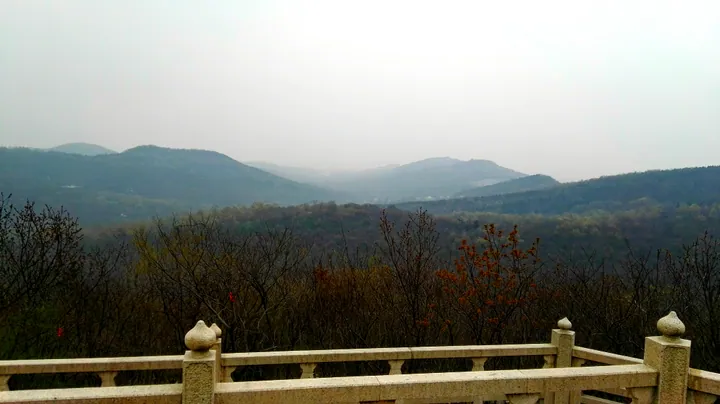
Photo adjustments
Full frame retained; proportionally resized and converted to WebP. No retouching or changes to the photographed subject. Card displays may crop the view.
Explore the region
About Bagong Mountain
Bagong Mountain (八公山) is a range of more than forty peaks in Huainan (淮南), Anhui, on the boundary of Bagongshan District (八公山区) and Shou County (寿县). It lies 2 km north of the old town of Shou County.
The range runs north to south as an outlier of the Dabie Mountains (大别山). Its highest point, Bai'e Peak (白鹗山), reaches 241.1 m. Over 10 km² of the hills carry natural secondary forest, and more than ten springs rise here, among them Pearl Spring (珍珠泉) and Agate Spring (玛瑙泉). The ground also shows karst features, including a stone forest.
The name refers to Liu An (刘安), a Western Han prince of Huainan, and the eight favoured retainers, the "Eight Lords" (八公), with whom he was said to have ascended as an immortal. The Huainan city government credits Liu An with gathering scholars here, compiling the Huainanzi (淮南子), setting out the full 24 solar terms for the first time and inventing tofu. In 383, during the Eastern Jin, the Battle of Feishui (淝水之战) was fought near the mountain. Fu Jian (苻坚), who led the Former Qin attack, is said to have taken the trees and grass on its slopes for Eastern Jin troops, which gave rise to the idiom "every bush and tree looks like a soldier" (草木皆兵).
Fossils found here in 1978 include the "Huainan worm" (淮南虫), dated to about 800 million years ago; the city government calls them the earliest ancient biological fossils yet found in the world. Its listings run from provincial scenic area (1987) to national geopark (2001), national forest park (2002) and AAAA-rated tourist attraction (2003). Poets and writers including Li Bai (李白), Su Shi (苏轼) and Ouyang Xiu (欧阳修) are recorded as visitors.
What to look for
- Palace of the Prince of Huainan (淮南王宫), a 5,500 m² complex built in memory of Liu An
- Tomb of the Prince of Huainan (淮南王墓) on the southern slope of Wuzhu Mountain (五株山), an Anhui provincial protected site since 1986
- Tomb of Lian Po (廉颇墓), grave of the Warring States general, on the southwest slope of Fangniu Mountain (放牛山)
- The stone forest (石林), a large karst stone-forest landscape
- The geological museum (地质博物馆) built within the scenic area
- Baita Temple (白塔寺) and the Ascension Platform (升仙台)
- Bixia Yuanjun Temple (碧霞元君庙) on the summit of Siding Mountain (四顶山)
Location & getting there
Getting to Bagong Mountain
- Search for 八公山 with 淮南市 and 八公山区.
Find Bagong Mountain
八公山 · 八公山区
No reliable map pin yet: search by the Chinese name.
Sources & visit information
Written from the linked sources and checked sentence by sentence against quoted extracts by a separate reviewer on 2026-09-23. Opening hours, admission and access arrangements are not covered; confirm current visitor information with the site.
Some facts checked against Wikipedia contributors, "八公山" · CC BY-SA 4.0.