


Explore the region
About Bishan Village
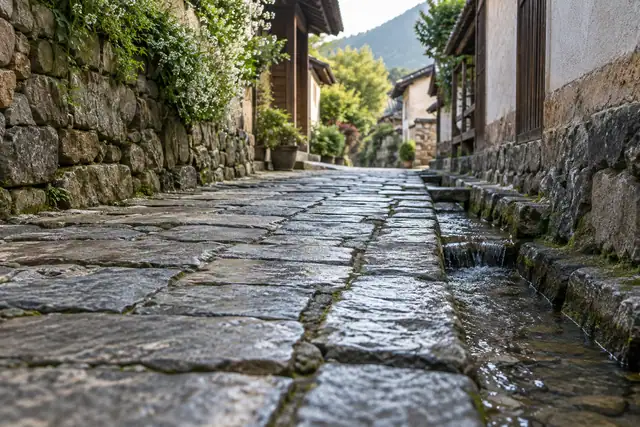
Bishan Village (碧山村) is an old Huizhou-style (徽州) clan village in Biyang town (碧阳镇), Yi County (黟县), Huangshan (黄山), Anhui, set on the southern foot of Bishan hill (碧山), the hill that gave it its name.
The village sits about 4 km northwest of Biyang, the county seat. Its old name was Huangpi (黄陂), and in the Ming dynasty it formed Sandu (三都), one of the twelve rural divisions of Yi County. The present administrative village was created in 2008 by joining Bidong (碧东) and Bixi (碧西). Forest covers about 70 percent of its land.
Bishan is where the Wang (汪) lineage of Yi County first settled together; it is counted with Hongcun (宏村) and Guanlu (关麓) among the county's three main Wang villages. Its notable men include Wang Bo (汪勃), who passed the palace examination in 1132 under the Southern Song and rose to the Bureau of Military Affairs. The village once counted 36 ancestral halls, 72 small squares and 104 wells. In the Taiping war, Qing and Taiping armies fought back and forth in Yi County for nine years, and Zeng Guofan's (曾国藩) Xiang Army was quartered for several years in the Wang clan's grand ancestral hall at Bishan.
More than a hundred Ming- and Qing-dynasty houses and ancestral halls survive, and in August 2013 Bishan joined the second national list of Chinese Traditional Villages (中国传统村落). From 2011 artists and curators including Ou Ning (欧宁) and Zuo Jing (左靖) promoted the Bishan Project (碧山计划), an attempt to bring art into rural life that opposed turning the village into a scenic area; Ou Ning, its initiator, left in 2016. In 2014 Nanjing's Librairie Avant-Garde (先锋书店) opened its eighth branch, the Bishan Bookstore (碧山书局), inside Qitai Hall (启泰堂), a Qing-dynasty ancestral hall, and in 2015 Zuo Jing turned the village's supply-and-marketing cooperative, built in 1962, into the Bishan Gongxiaoshe (碧山工销社).
What to look for
- Bishan Wang Clan Ancestral Hall (碧山汪氏世祠), the Qing-built head hall of the 36 Wang ancestral halls the village once had, five bays wide and two sections deep; an Anhui provincial protected site since 2019
- Yunmen Pagoda (云门塔), a Huangshan city-level protected site
- Bishan Bookstore (碧山书局), a bookshop in the Qing-dynasty Qitai Hall (启泰堂)
- Renzi Street (人字街) and Peiyun Garden (培筠园), which keep much of their old appearance
- Zhangshan inscribed cliff (章山题壁), a city-level protected site
- Xiaoyu Garden (筱馀园), a county-level protected site
- Bishan Gongxiaoshe (碧山工销社), a 1962 cooperative store converted in 2015
Location & getting there
Getting to Bishan Village
- Search for 碧山村 with 黄山市 and 黟县.
Find Bishan Village
碧山村 · 黟县
No reliable map pin yet: search by the Chinese name.
Sources & visit information
Written from the linked sources and checked sentence by sentence against quoted extracts by a separate reviewer on 2026-09-23. Opening hours, admission and access arrangements are not covered; confirm current visitor information with the site.
Some facts checked against Wikipedia contributors, "碧山村" · CC BY-SA 4.0.
Some facts checked against Wikipedia contributors, "碧山汪氏世祠" · CC BY-SA 4.0.