

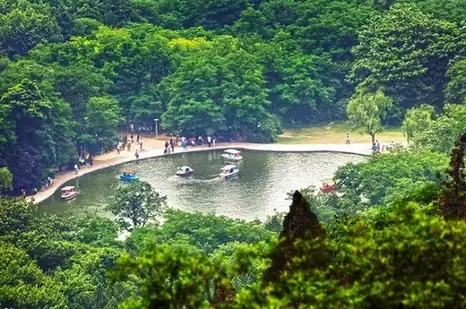
Photo adjustments
EXIF orientation normalized; resized without changing aspect ratio; converted to WebP. No subject edits.
Explore the region
About Xiangshan Park
The temple’s foundation is dated to the Western Jin dynasty in 284, while its surviving structures are Qing buildings arranged around three courtyards. Locally it is often called Xiangshan Temple. In the Yushu Pavilion, a stone inscription preserves the Qianlong emperor’s calligraphy Hui wo nan li; the original hanging plaque has been lost. The inscription belongs to the temple’s eighteenth-century rebuilding history and local concern with flooding.
The park also has a cultivated urban landscape around this older religious centre. Privet trees line East Avenue, and cedars form a grove by the East Gate, adding tree-lined approaches to the temple and hillside setting.
What to look for
- Xiantong Temple’s sequence of three courtyards and Qing architectural structures.
- The stone copy of Qianlong’s Hui wo nan li inscription in the Yushu Pavilion.
- The privet-lined East Avenue and cedar grove at the East Gate.
Location & getting there
Getting to Xiangshan Park
Check weather, trail access and the last return service. A mountain or forest area is not one entrance, and a map’s central pin may be far from the trailhead.
- Search for 相山公园 with 淮北市 and 相山区.
Find Xiangshan Park
相山公园 · 相山区
No reliable map pin yet: search by the Chinese name.
Sources & visit information
The linked sources support the identity and background described in this introduction. Opening hours, admission, activity availability and exact arrival arrangements have not been comprehensively checked. Confirm current visitor information with the venue; the original catalogue locality and editorial review flag are retained.