

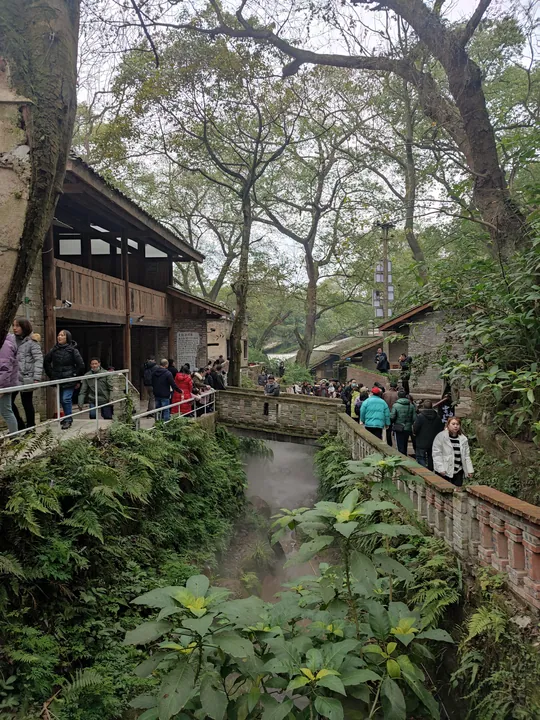
Photo adjustments
Full frame retained; proportionally resized and converted to WebP. No retouching or changes to the photographed subject. Card displays may crop the view.
Explore the region
About Jingangbei Old Village
The Chongqing Civil Affairs Bureau's place-name account gives the settlement a history of more than three hundred years and traces its rise to coal mining. From the Kangxi reign of the Qing there were many small pits on the southern slope of Jinyun Mountain; coal was carried through Jingangbei and shipped out along the Jialing River, and a combined land-and-water wharf for moving and selling coal formed at the village. By the Tongzhi reign the trades had organised a guild association known as the Seven Guilds, headed by coal, salt, boats, pack transport, oxen, horses and rice, and the village supported shops, inns, teahouses and taverns. By the Republican period several larger clusters of dwellings had taken shape, among them Yaojia yuanzi, Xiongjia yuanzi and Zhengjia yuanzi.
Because the village lay hidden deep in the hills, it became a refuge during the War of Resistance, and the bureau's account puts some three thousand arrivals here, Nationalist government departments together with figures from science, culture, education and business. Zhang Bojun, a member of the People's Political Council, used the hillside ground to solve the tanning process's water problem and established the Limin tannery; the Central Relief Commission's Limin leather works formally opened for business in 1939. In 1941 Liang Shuming founded Mianren Middle School here with the support of Lu Zuofu and Lu Ziying. Beibei District launched a repair and restoration project for the historic and cultural block in 2017, working from the existing landscape setting, the traditional street-and-lane spaces and the cultural relics and historic buildings on the site; the Civil Affairs Bureau dates the overall renovation to 2018, and the restored village opened as a scenic area and resort in early 2022.
What to look for
- The boulder known locally as lishizi, more than seven metres high and more than two metres thick and shaped like a stele, with one side running down into the Jialing River; local tradition holds that the two characters jin gang were carved on it in the Tang dynasty and gave the place its name.
- The larger clusters of dwellings recorded here from the Republican period, named in the place-name account as, among others, Yaojia yuanzi, Xiongjia yuanzi and Zhengjia yuanzi.
- The lie of the ground: hills closing in on both sides of the village, with the middle, held in a bend of the Jialing River, opening out broad.
- The tall old trees over the village, noted in the bureau's description alongside its hills and water.
Location & getting there
Getting to Jingangbei Old Village
Identify the main visitor approach and any separately managed houses, museums or performances. Ask before entering residential spaces or photographing residents.
- Search for 金刚碑古村 with 重庆市 and 北碚区.
Find Jingangbei Old Village
金刚碑古村 · 北碚区
No reliable map pin yet: search by the Chinese name.
Sources & visit information
The linked sources support the identity and background described in this introduction. Opening hours, admission, activity availability and exact arrival arrangements have not been comprehensively checked. Confirm current visitor information with the venue; the original catalogue locality and editorial review flag are retained.