

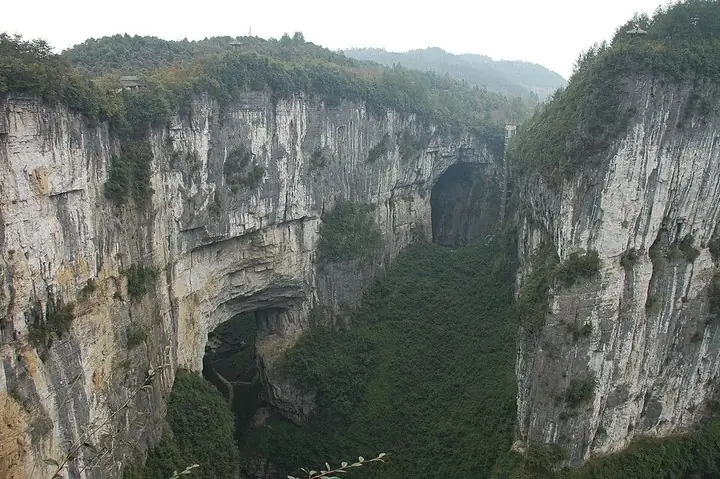
Photo adjustments
Full source framing retained; proportionally resized and converted to WebP. No retouching or subject alteration. Card displays may crop the view.
Explore the region
About Three Natural Bridges
Three Natural Bridges (天生三桥) is a group of three karst rock arches over the Yangshui River (羊水河), a tributary of the Wu River (乌江), on the east side of Xiannüshan Town (仙女山镇) in Wulong District, Chongqing, 20 km from the district's urban centre.
The three arches, formed in Triassic limestone, stand one after another from west to east along a 1.2 km gorge in the middle course of the Yangshui. Between them open two sinkholes, Qinglong Tiankeng (青龙天坑) and Shenying Tiankeng (神鹰天坑), 276–285 m deep and 300–522 m across. The Chongqing local chronicles office calls the group the largest set of natural bridges in Asia. A Ming geography, the Ming Yitong Zhi (明一统志), already recorded a dragon-shaped "Longqiao Mountain" (龙桥山) with a deep hollow beneath it, fifty li east of Wulong.
The scenic area first opened to visitors in April 2000. UNESCO added the Wulong Karst, with the bridges as its leading site, to its natural heritage roll on 27 June 2007 under the South China Karst listing, which made it China's sixth natural World Heritage Site; the scenic area gained its national 5A rating on 6 July 2011. It also belongs to the Wulong Karst National Geopark.
A 2,300 m walking route runs through the scenic area, passing Qinglong Bridge 950 m and Heilong Bridge 1,200 m from the entrance. Some 600 m in from the entrance is Tianfu Official Post Station (天福官驿), named after a courier stop on the old official road between Fuzhou (涪州) and Qianzhou (黔州); the grey-walled courtyard house was rebuilt in 2006 for the filming of Zhang Yimou's film Curse of the Golden Flower (满城尽带黄金甲). Beside the main bridge, a side cave leads south towards Baiguo (白果) and holds stalactites and stone forests.
What to look for
- Tianlong Bridge (天龙桥, "Sky Dragon"), 235 m high and 150 m thick, with two openings, a south arch and a north tunnel
- Qinglong Bridge (青龙桥, "Azure Dragon"), the tallest of the three, named for the rainbows seen in its arch after rain
- Heilong Bridge (黑龙桥, "Black Dragon"), 223 m high with a dark 193 m passage
- Four named springs issuing from the upper north wall of the Heilong Bridge passage, including Three-Tier Spring (三叠泉) and Pearl Spring (珍珠泉)
- Qinglong and Shenying sinkholes between the bridges
- Tianfu Official Post Station (天福官驿), the courtyard house rebuilt in 2006 for Curse of the Golden Flower
Location & getting there
Getting to Three Natural Bridges
- Search for 天生三桥 with 重庆市 and 武隆区.
Find Three Natural Bridges
天生三桥 · 武隆区
No reliable map pin yet: search by the Chinese name.
Sources & visit information
Written from the linked sources and checked sentence by sentence against quoted extracts by a separate reviewer on 2026-09-23. Opening hours, admission and access arrangements are not covered; confirm current visitor information with the site.
Some facts checked against Wikipedia contributors, "天生三桥" · CC BY-SA 4.0.