

Li-Style Bamboo Tube Rice 黎家竹筒饭
Li-Style Bamboo Tube Rice is featured among the local specialties of Hainan.
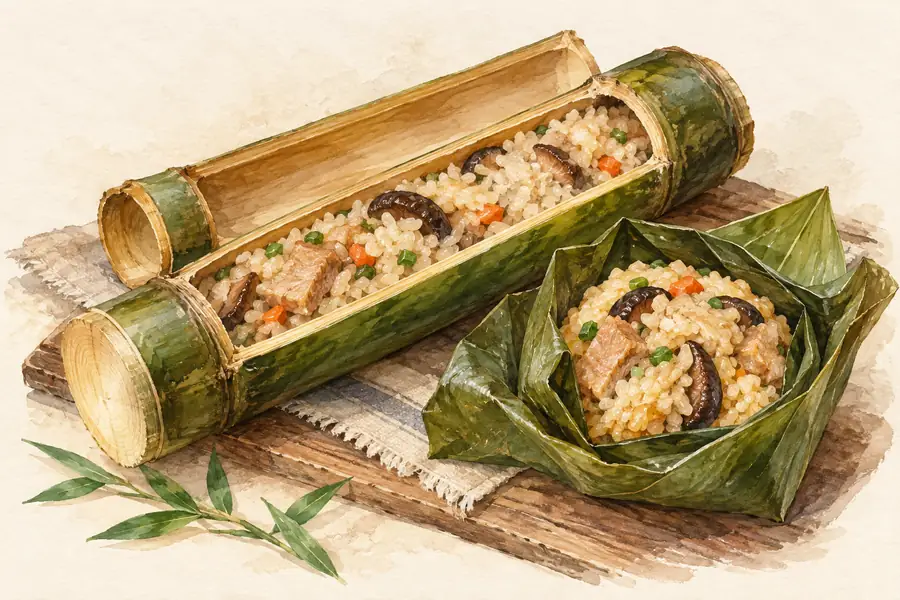
Li-Style Bamboo Tube Rice (黎家竹筒饭) is rice cooked inside a length of fresh bamboo over a charcoal fire, a traditional food of the Li (黎族) people of Hainan. In Dongfang (东方) it was on the Li long-table banquet menu planned at the Hualigu Cultural Tourism Area (花梨谷文化旅游区), a sub-venue of the Dongfang main venue for the 2026 Sanyuesan (三月三) festival, according to a Hainan Daily (海南日报) report carried by the provincial tourism department.
How it is made
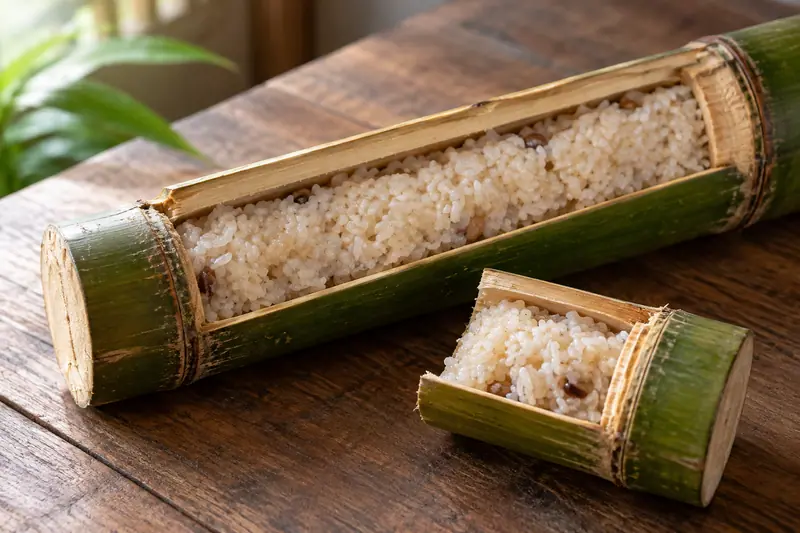
According to Hainan Online (海南在线), Li cooks usually take the fragrant rice (香米) among the varieties of Shanlan rice (山兰稻), and saw fresh fenzhu (粉竹) or mountain bamboo into sections 20 to 30 centimetres long. The soaked rice goes into each tube with a measure of water, the opening is sealed with banana leaf, and the tube is roasted slowly over charcoal. The rice is done when the bamboo skin has turned from green to charcoal black.
Versions are named after their ingredients and the way they are made. Meat rice (肉香饭) adds chicken or pork seasoned with five-spice powder; there are also salt rice (盐巴香饭) and black-bean rice (黑豆香饭).
Where it comes from
Li families once made it only when setting out on a long journey, hunting in the hills or receiving guests. The tubes are easy to carry, and the rice served as a meal on outings in the open. It now also appears at major festivals such as Sanyuesan.
How it is eaten
At a Sanyuesan long-table banquet the tables are covered with banana leaves and laid with dishes such as three-colour rice, bamboo tube rice, white-cut chicken and wild greens. The menu planned for the 2026 Dongfang banquet at Hualigu set it alongside five-colour rice, Shanlan wine (山兰酒), huanghuali chicken (黄花梨鸡) and roast wujiao pig (烤五脚猪).
In Changjiang Li Autonomous County (昌江黎族自治县), on the west of Hainan Island, the rice is seasoned and roasted in fresh bamboo. CNR (央广网) describes the bamboo sections as bright green and the rice as sauce-yellow, soft and chewy, eaten with a sip of Shanlan wine.
Sources & reading
Written from the linked sources and checked sentence by sentence against quoted extracts by a separate reviewer on 2026-09-23. Recipes and servings vary between kitchens.