

Dongpo Pork 东坡肉
Dongpo Pork is featured among the local specialties of Sichuan.
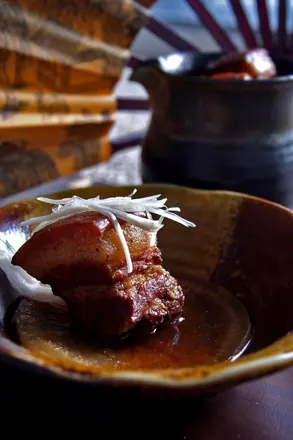

Photo adjustments
Resized and WebP compressed; subject not altered.
Dongpo Pork (东坡肉) is a slow-braised pork dish named for the poet Su Dongpo: blocks of pork belly cooked with soy sauce, rock sugar and Shaoxing wine until dark and tender. It is recorded for Sichuan.
How the pork is cooked
The source gives the build: pork belly is braised slowly with soy sauce, rock sugar and Shaoxing wine until it takes colour and softens. The cut is usually a cube of about two 寸, deliberately half fat and half lean, so that a long braise has something solid to hold together. A Yuan-dynasty recipe, the 烧猪肉 in Ni Zan's 云林堂饮食制度集, is described as already close to the modern method.
Taste and texture
Long braising in soy, sugar and wine produces the profile the dish is known for: dark, glossy and sweet-savoury, with the fat softened enough to give way under a spoon. Because the blocks are large, the meat is cut into slices rather than served as small pieces, and the seasoning is concentrated where the braise has reduced around the surface.
Su Dongpo's name, two different regions
The source places the dish in Jiangsu-Zhejiang cuisine and describes it as said to have been created by Su Dongpo refining an older method; it also records the name 东坡肉 appearing in Ming writing by 冯梦龙 and 沈德符. The same name is filed under Sichuan, in 眉山, the poet's own region. Culinary home and catalogue geography therefore point at different places, and that difference is worth keeping visible rather than smoothing over.
What is in the braise
Pork belly is the base, with soy sauce, rock sugar and Shaoxing wine named as the seasoning. The wine means the braising liquid contains alcohol, although most of it cooks off over a long simmer; ask if you are avoiding alcohol entirely. The dish is built on pork fat, so there is no lean version of the classic form, and the sauce is part of the dish rather than something to be drained off.
Ordering it
This is a rich dish, normally shared as one of several at a table rather than eaten on its own, and a portion is usually a block or two per person. Ask how many blocks come in an order and whether plain rice is served with it, because the braise is intense and most people want something neutral beside it.
How it is eaten and where it travelled
The source records that the dish reached Ryukyu and Japan by sea during the Ming dynasty, where the Okinawan 罗火腿 (ラフテー) and the Kyushu 角煮 developed from it. At the table the block is sliced and eaten with rice, and the dark sauce is spooned over rather than left in the pot.
More dishes to compare
Explore related local specialties and compare their names, preparation notes and ordering guidance.
Twice-cooked pork 回锅肉 →
Twice-cooked pork (回锅肉) is also pork, but the method runs the other way: the meat is cooked first, then sliced and returned to the wok with seasonings to finish quickly, so it arrives as thin coated slices. 东坡肉 keeps the pork in large cubes and gives it a long, slow braise in soy sauce, rock sugar and wine until the block softens.
Questions before you order
Why is it called 东坡肉?
The source ties the name to Su Dongpo, describing the dish as said to have been created by him refining an older method and recording the name in Ming writing by 冯梦龙 and 沈德符.
Is 东坡肉 a Sichuan dish?
The source calls it a famous dish of Jiangsu-Zhejiang cuisine, while the name sits under Sichuan, in 眉山, Su Dongpo's own region. The two point at different places, so treat the listing as a name-level entry and check the attribution.
Source introduction: Wikipedia contributors: 东坡肉 · CC BY-SA 4.0. English translation and adaptation of the cited introduction, with additional preparation and ordering guidance.
Sources & reading
Named culinary source added during the audit. Source origin and local variants remain distinct; this is not a claim that all preparations have been individually verified.