

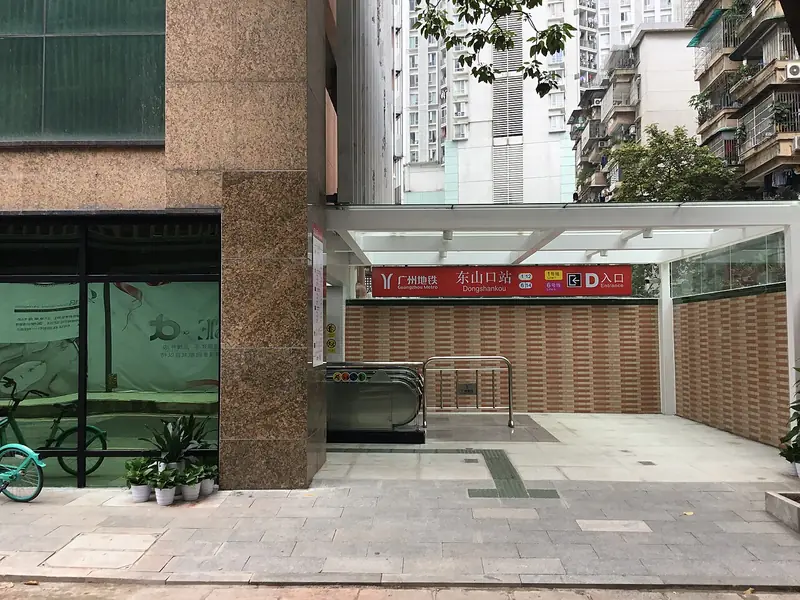
Photo adjustments
Full frame retained; EXIF orientation normalized, proportionally resized to at most 800 pixels and converted to WebP. No generated pixels or subject changes. Cards may crop the display.
Explore the region
About Dongshankou Historic District
There is no mountain at Dongshan. The name goes back to a Ming-period temple east of the old walled city, and the rises here are low mounds. The area developed late: after the Canton-Kowloon Railway opened in 1911, emigrants of Guangdong origin returning from abroad found the old city and Xiguan already crowded and turned to this side of town. In 1915 a group led by Huang Kuishi bought eighteen mu of waste ground at Guigang, cut roads across it and sold plots, laying out Shuqian Road, Qiming Dama Road, Xuguyuan Road and Xinhepu Road. Over the following decades, from the mid-nineteenth century to the eve of the war with Japan, 785 villas were built at Dongshan by overseas Chinese, forming three clusters: Guigang-Qiming, Xinhepu and Songgang, later renamed Meihuacun.
The Dongshan villa is a recognisable type in its own right. It keeps the courtyard logic of a Lingnan house, with a front court and a rear yard, but the elevations are Western and the walls are fair-faced red brick, which sets the quarter apart from the grand houses, arcades and tube houses of the western city. Xinhepu is the largest surviving group of these low-rise courtyard buildings in Guangzhou, with more than 400 of them, and was placed among the city's first historic conservation districts; the villa area as a whole was designated in 2000, and a 2019 conservation plan for Xinhepu brought 493 villas within its scope. The quarter received a UN Asian Townscape Award in 2019.
Individual houses carry their own histories. Kuiyuan on Xuguyuan Road is a three-storey reinforced-concrete villa built by the emigrant Ma Zhuowen, and it stands next to the building where the Chinese Communist Party held its Third National Congress in 1923, now a memorial museum; Chunyuan on Xinhepu Road served as the party's central office that year. Yuyuan, at 42 Sibei Tongjin, was built around 1932 by the naval architect Wu Jingying in an English manner, with Chinese bell-flower brackets under the balcony. Even the street names record the quarter's making: Sibei Tongjin means the road behind Dongshan Temple leading to the landing stage. Most of the villas remain private, so the quarter is read from the street rather than entered.
What to look for
- The fair-faced red-brick villa fronts with front courts and rear yards, the building type that distinguishes Dongshan from western Guangzhou
- Kuiyuan on Xuguyuan Road, a three-storey reinforced-concrete villa built by the emigrant Ma Zhuowen
- Yuyuan at 42 Sibei Tongjin, built around 1932 by the naval architect Wu Jingying, English in manner but with Chinese bell-flower brackets on the balcony
- The memorial museum at the site of the Chinese Communist Party's Third National Congress, and Chunyuan on Xinhepu Road
- The 1915 street grid at Guigang, including Shuqian Road and Qiming Dama Road, laid out when the plots were first sold
Location & getting there
Getting to Dongshankou Historic District
Choose a precise starting address and return transport stop. Access to individual buildings, performances or viewing platforms is separate from access to public streets.
- Search for 东山口 with 广州市 and 越秀区.
Find Dongshankou Historic District
东山口 · 越秀区
No reliable map pin yet: search by the Chinese name.
Sources & visit information
The linked sources support the identity and background described in this introduction. Opening hours, admission, activity availability and exact arrival arrangements have not been comprehensively checked. Confirm current visitor information with the venue; the original catalogue locality and editorial review flag are retained.