

Photo adjustments
EXIF orientation normalized; resized without changing aspect ratio; converted to WebP. No subject edits.
Explore the region
About Fenghuang Old Village and Fenghuang Mountain
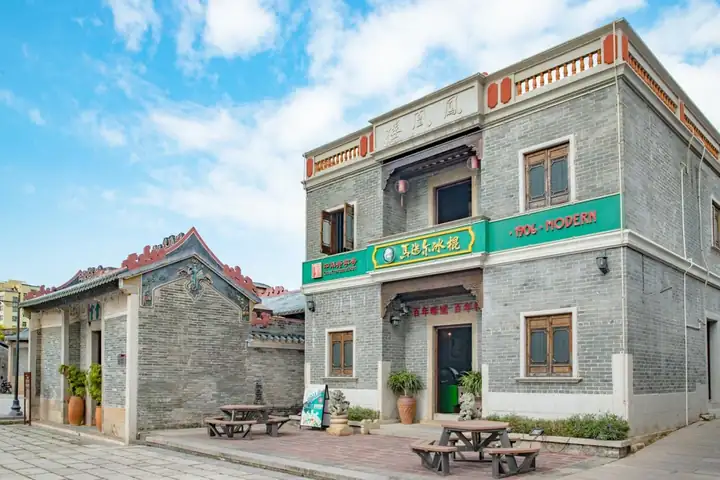
The village stands at the northern foot of the mountain and has a recorded history of more than seven hundred years as the home of descendants of the lineage of Wen Tianxiang, the Song loyalist statesman. Around 360 old buildings survive, among them 69 Ming and Qing dwellings, 96 buildings from the Republican period, five private study halls, twelve ancestral halls, thirteen old wells and twelve old trees, threaded by six main lanes and thirty-five smaller ones. Houses follow the comb-like arrangement typical of the region, most of them two bays deep and three bays wide with two halls, a light well and side corridors, and their gable walls and door eaves carry figure and floral ornament. Shenzhen Evening News, in an article carried by People's Daily Online, calls it the largest and best preserved group of southern Cantonese village architecture in the Shenzhen area.
Fenghuang Mountain Forest Park occupies the west of Bao'an District, a crescent of hills whose main peak reaches 376 metres and whose planned area of about 27.65 square kilometres extends across the Fuyong, Hangcheng, Xinqiao, Gongming and Shiyan subdistricts, with views west to Lingding Yang and south to Shenzhen Bay. Its two named cultural features are the Fengyan Ancient Temple and the Wangyan Tower. The temple was founded in the Dade era at the beginning of the Yuan dynasty by Wen Yinglin, a grand-nephew of Wen Tianxiang, and is over six hundred years old; the tower is a viewing point above the reservoirs and subdistricts to the north.
What to look for
- Fenghuang Pagoda, a hexagonal six-storey pavilion-style tower of brick and timber standing 20 metres high at the edge of the village
- The comb-like grid of six main lanes and thirty-five side lanes between grey-brick, grey-tiled houses of two halls and a light well
- The Gusan Study Hall, one of five private study halls, which served as classrooms for the village school into the 1970s
- Fengyan Ancient Temple on the mountain, founded in the Yuan-dynasty Dade era by Wen Yinglin, a grand-nephew of Wen Tianxiang
- The Wangyan Tower viewing point, looking towards Apojie Hill and the Tiegang and Jiulongkeng reservoirs
Location & getting there
Getting to Fenghuang Old Village and Fenghuang Mountain
Check which interiors and courtyards are accessible. Active places of worship and protected monuments may have different visitor rules.
- Search for 凤凰古村与凤凰山 with 深圳市 and 宝安区.

Find Fenghuang Old Village and Fenghuang Mountain
凤凰古村与凤凰山 · 宝安区
No reliable map pin yet: search by the Chinese name.
Sources & visit information
The linked sources support the identity and background described in this introduction. Opening hours, admission, activity availability and exact arrival arrangements have not been comprehensively checked. Confirm current visitor information with the venue; the original catalogue locality and editorial review flag are retained.