

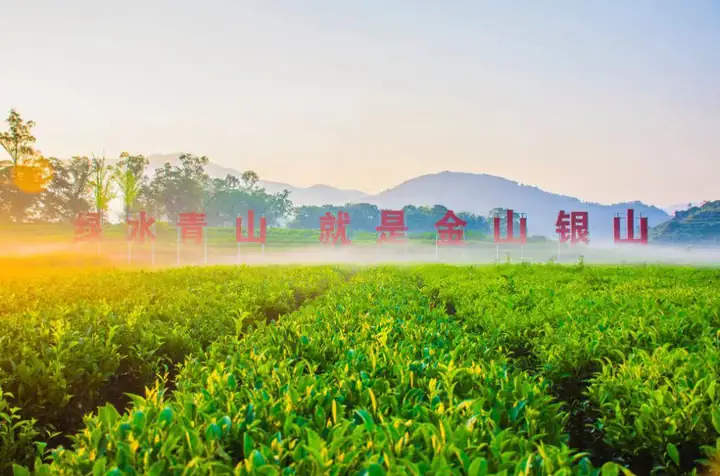
Photo adjustments
EXIF orientation normalized; resized without changing aspect ratio; converted to WebP. No subject edits.
Explore the region
About Fenghuang Mountain Tea District
Fenghuang dancong tea begins at the end of the Southern Song, a span the district media centre puts at more than 700 years. The heritage tea-tree resources lie mainly on middle and high slopes between about 600 and 1,200 metres. A systematic survey organised in 1980 counted more than 3,700 ancient tea trees over 200 years old; a more recently compiled register of dancong ancient tea trees gives 4,682 such trees surviving on Fenghuang Shan. Fenghuang town's deputy head has put the town's stock at more than 15,000 trees over a hundred years old and more than 4,600 over two hundred, mainly in Wudong and Fengxi villages, with an annual output near 50,000 jin. At the date of the ministry's entry the town had more than 60,000 mu of tea garden and produced over three million kilogrammes of tea a year.
The Da'an ancient tea garden, at about 1,000 metres, holds more than 1,000 mu of old trees growing in a continuous block. The oldest of them, the Da'an Songzhong, has been rooted there for close to 600 years and is a natural hybrid descendant of the old Song tea of Wudong Shan; its keeper, Huang Baoguo, gives its aroma type as huangzhi xiang and its dimensions as roughly seven to eight metres of crown and about eight metres of height. Older trees are scattered rather than ranked in rows, set behind and in front of houses or on rocky slopes: one about four metres tall in the gardens of Zimao village in Fengxi is identified by a tea farmer as a milanxiang bush planted in his grandfather's generation, and another on a half-slope at close to 800 metres on Wudong Shan is put by a farmer at about four hundred years old and of the shuixian line. The ministry's entry also records how fragile the stock is: 80 ancient trees died between 1996 and 1998 alone, and it treats them as non-renewable genetic material.
What to look for
- The Da'an ancient tea garden at about 1,000 metres, more than 1,000 mu of old trees growing in one block.
- The Da'an Songzhong, close to 600 years in the ground, about eight metres tall with a crown of seven to eight metres.
- Scattered old trees still picked around Wudong Shan, including a milanxiang bush of more than a hundred years at Zimao village in Fengxi.
- A shuixian-line tree on a half-slope at close to 800 metres on Wudong Shan, put by its farmer at about four hundred years old.
- The altitude band between roughly 600 and 1,200 metres, where the ministry places the dancong heritage tea-tree resources.
Location & getting there
Getting to Fenghuang Mountain Tea District
Check weather, trail access and the last return service. A mountain or forest area is not one entrance, and a map’s central pin may be far from the trailhead.
- Search for 凤凰山茶区 with 潮州市 and 潮安区.

Find Fenghuang Mountain Tea District
凤凰山茶区 · 潮安区
No reliable map pin yet: search by the Chinese name.
Sources & visit information
The linked sources support the identity and background described in this introduction. Opening hours, admission, activity availability and exact arrival arrangements have not been comprehensively checked. Confirm current visitor information with the venue; the original catalogue locality and editorial review flag are retained.