

Photo adjustments
EXIF orientation normalized; resized without changing aspect ratio; converted to WebP. No subject edits.
Explore the region
About Leizhou Ancient City and Sanyuan Pagoda
Leizhou sits in the middle of the peninsula, with the South China Sea to the east and the Gulf of Tonkin to the west, commanding the Qiongzhou Strait; the city government describes it as a meeting point of Chu-Yue, indigenous, southern-Fujian-migrant, maritime and Central Plains cultural strands. As a national historic and cultural city it holds numerous monuments besides the pagoda, among them the Fubo Shrine, commemorating a Han-dynasty general who held the Fubo title, the Tang-dynasty Leizu Shrine, the Lingnan temple Tianning Chan Monastery, Leizhou West Lake, where the Song-dynasty 'Ten Worthies' left their traces, and the old residential quarter of Bangtang. The city is recorded as having more than 100 old villages, more than 200 old kiln sites, more than 800 old tombs, more than 1,000 old buildings and more than 100 old temples, with 9 villages on the national list of traditional villages.
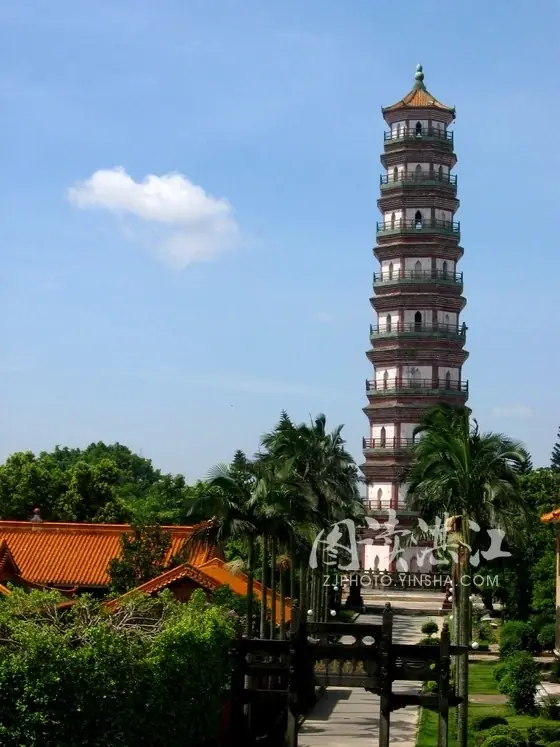
The pagoda itself stands in Sanyuan Pagoda Park, at Qujie in Leicheng town, a park of just over 30,000 square metres entered through a paifang-style gate with a red roof, four pillars and three marble-faced bays; the inscription giving the park's name is by the former Guangdong provincial governor Zhu Senlin. The park is divided into a front section given over to sport and recreation and a rear section that is the historic-monument area. Work on the pagoda began in the first month of the 41st year of the Wanli reign (1613) and it was completed in the fourth month of the 43rd year (1615); it was first named Wenkui Pagoda and also called Qixiu Pagoda, then renamed Sanyuan Pagoda after three snake eggs were found while its foundation was being dug and were read as an omen of taking first place in all three imperial examinations. It rises through seventeen interior storeys in corbelled courses of moulded brick that taper upward from a wide base, and the Leizhou parks page describes it as octagonal in plan and built entirely of brick, while the Zhanjiang municipal page describes the same pagoda as a brick-and-timber pavilion-type structure; it stands on a carved stone sumeru-form plinth carrying 23 Ming-dynasty relief carvings, and is registered as a provincial-level protected cultural relic. The park also contains the Ergong Ci, a shrine to two Qing-dynasty worthies of Leizhou, Chen Bin and Chen Changqi.
What to look for
- The Sanyuan Pagoda, an octagonal pagoda of seventeen interior storeys, built between 1613 and 1615 and renamed for the 'three firsts' omen found at its foundation.
- The 23 Ming-dynasty relief carvings on the pagoda's stone plinth, recorded by the Zhanjiang municipal page; the Leizhou parks page separately records the plinth's carved designs as including a monkey picking peaches, paired deer with swallows, paired phoenixes facing the sun, a carp leaping the dragon gate, white cranes with pines, and lions playing with a ball.
- The Ergong Ci within the park, a shrine to the Qing-dynasty Leizhou worthies Chen Bin and Chen Changqi.
- The park's paifang-style entrance gate, with its name inscribed by former Guangdong provincial governor Zhu Senlin.
- Elsewhere in the old city, the monuments the city government lists alongside the pagoda: the Fubo Shrine, the Tang-dynasty Leizu Shrine, Tianning Chan Monastery, Leizhou West Lake and the Bangtang old residential quarter.
Location & getting there
Getting to Leizhou Ancient City and Sanyuan Pagoda
Identify the main visitor approach and any separately managed houses, museums or performances. Ask before entering residential spaces or photographing residents.
- Search for 雷州古城与三元塔 with 湛江市 and 雷州市.
Find Leizhou Ancient City and Sanyuan Pagoda
雷州古城与三元塔 · 雷州市
No reliable map pin yet: search by the Chinese name.
Sources & visit information
The linked sources support the identity and background described in this introduction. Opening hours, admission, activity availability and exact arrival arrangements have not been comprehensively checked. Confirm current visitor information with the venue; the original catalogue locality and editorial review flag are retained.