

Photo adjustments
Full frame retained; proportionally resized and converted to WebP. No retouching or changes to the photographed subject. Card displays may crop the view.
Explore the region
About Nankun Mountain
Nankun Mountain (南昆山) is a forested upland in the southwest of Longmen County (龙门县), Huizhou (惠州), on the border with Guangzhou. The Tropic of Cancer crosses it, which gave it the nickname 'oasis on the Tropic of Cancer' (北回归线上的绿洲).
The main peak, Tiantang Ding (天堂顶, 'Heaven's Summit'), stands on the boundary between Yonghan town (永汉镇) in Longmen and Liangkou town (良口镇) in Guangzhou's Conghua District (从化区). It takes its name from the cloud that wraps the top for much of the year, so that it seems to float in the sky. The scenic area gives its height as 1,228 m; Chinese Wikipedia's article on the peak gives 1,210 m and calls it the highest point in Guangzhou. The peak is mostly biotite granite. Below about 1,000 m grows subtropical evergreen forest of the beech, laurel, tea, witch-hazel and magnolia families; higher up it opens into mountain meadow. The scenic area, with an average altitude above 600 m, lists 240,000 mu of primeval forest and 60,000 mu of bamboo.
Guangdong's provincial government created a nature reserve here in 1984. It records 194 families of plants with 703 genera and 1,519 species, among them Fujian cypress (福建柏), camphor and black tree fern (黑桫椤), all under China's second-class protection. Of its 295 animal species, three under first-class protection are the clouded leopard, the forest musk deer and the python. The Ministry of Forestry approved a national forest park in 1993, and in 2007 the National Tourism Administration rated the eco-tourism area a national AAAA attraction. Provincial road S355 runs through the mountain, linking Yonghan with Zengcheng (增城) in Guangzhou.
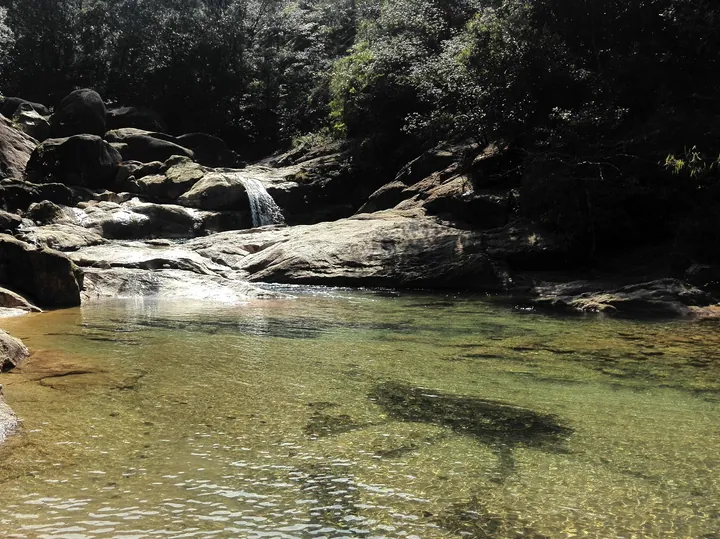
The scenic area names more than 30 sights. About half a kilometre from the tourist centre, the Stone River (石河奇观) is a stretch of stream strewn with odd rocks, with seven small pools below a larger, clear pool, Fairy Pool (仙女潭). Two boulders by the pool are called the Skirt Stone, and a rock in the stream the Mirror Stone, after a legend of seven fairies who bathed there. Chuanlong Waterfall (川龙瀑布) drops from a dragon-head-shaped hole in a cliff at the end of a gorge deep in the bamboo, and the cliff bears the name 'Chuanlong Gorge' (川龙峡) carved in the hand of the calligrapher Qin Esheng (秦萼生). Guanyin Pool (观音潭), 4 km west of Nankunshan town, is a three-step waterfall on a mountain stream; behind the veil of the lowest fall a white rock looks like the goddess Guanyin seated beside the green pool. Seven Fairies Lake (七仙湖) is a reservoir built among seven small hills called the Seven Star Mounds (七星墩).
What to look for
- Tiantang Ding (天堂顶), the cloud-wrapped main peak, with mountain meadow above about 1,000 m
- The Stone River (石河奇观), seven small pools below Fairy Pool (仙女潭), with the Skirt and Mirror stones
- Chuanlong Waterfall (川龙瀑布), falling from a dragon-head-shaped hole at the end of a bamboo gorge
- Guanyin Pool (观音潭), a three-step waterfall with a Guanyin-like white rock behind the lowest fall
- Seven Fairies Lake (七仙湖) among the Seven Star Mounds (七星墩)
- Bamboo groves listed at 60,000 mu
Location & getting there
Getting to Nankun Mountain
- Search for 南昆山 with 惠州市 and 龙门县.

Find Nankun Mountain
南昆山 · 龙门县
No reliable map pin yet: search by the Chinese name.
Sources & visit information
Written from the linked sources and checked sentence by sentence against quoted extracts by a separate reviewer on 2026-09-23. Opening hours, admission and access arrangements are not covered; confirm current visitor information with the site.
Some facts checked against Wikipedia contributors, "南昆山国家森林公园" · CC BY-SA 4.0.
Some facts checked against Wikipedia contributors, "天堂顶" · CC BY-SA 4.0.