

Photo adjustments
Full frame retained; EXIF orientation normalized, proportionally resized to at most 800 pixels and converted to WebP. No generated pixels or subject changes. Cards may crop the display.
Explore the region
About Chung Ying Street
Chung Ying Street (中英街) is a street at Sha Tau Kok (沙头角) that forms part of Hong Kong's land border with Shenzhen (深圳), a row of boundary stones standing down its middle; the two sides administer it jointly, and the Shenzhen half belongs to Yantian District.
The line goes back to the 1898 treaty that enlarged Hong Kong (展拓香港界址专条), by which Britain leased the New Territories from the Qing government. Surveyors marked it here from 16 to 18 March 1899, drawing the eastern border along the highest water reached at high tide on the Sha Tau Kok River (沙头角河). The shallow river had dried up by the Second World War. Because the colonial government did not then restrict movement between the two sides, shops went up along both banks of the old bed, which became a street known as Chung Ying Street, or Luci Jing (鸬鹚径, "cormorant path"). After the Sha Tau Kok shootout of 8 July 1967, part of the 1967 riots, which left six dead and twenty injured, Hong Kong closed the border entirely; the Sha Tau Kok control point opened only after 1979.
In the 1990s mainland visitors came to buy foreign goods, mostly watches, clothing and jewellery. That trade faded in the early 2000s once most mainland residents could apply to visit Hong Kong directly, and the street turned into a place for historical sightseeing. Shenzhen lists it among its Eight Views of Shenzhen (深圳八景) under the title "One Street, Two Systems" (一街两制). As a destination, the name also covers the wider Sha Tau Kok border special management zone on the Shenzhen side, with memorial areas and reliefs, while the Hong Kong side keeps its frontier closed-area status and has only small shops.
Eight boundary stones stand in the middle of the street. Japanese forces pulled out stones 3 to 7 in December 1941 after occupying Hong Kong, and they were set up again at a ceremony in April 1948. Each stone reads "光緒二十四年 中英地界" ("24th year of Guangxu, Sino-British boundary") with its number on the Shenzhen face and "ANGLO·CHINESE BOUNDARY 1898" on the Hong Kong face. They became a Guangdong provincial heritage site in 1989, and in 2019 the five stones under Shenzhen's care were listed as a Major Historical and Cultural Site Protected at the National Level. Since 2002 Yantian District has marked every 18 March, the day the 1899 survey ended, with a ceremony at the square of the Chung Ying Street History Museum that includes ringing the Warning Bell.
What to look for
- The boundary stones down the centre of the street, marked in Chinese on the Shenzhen face and in English on the Hong Kong face
- Boundary stone No. 4, which stands under a century-old banyan tree
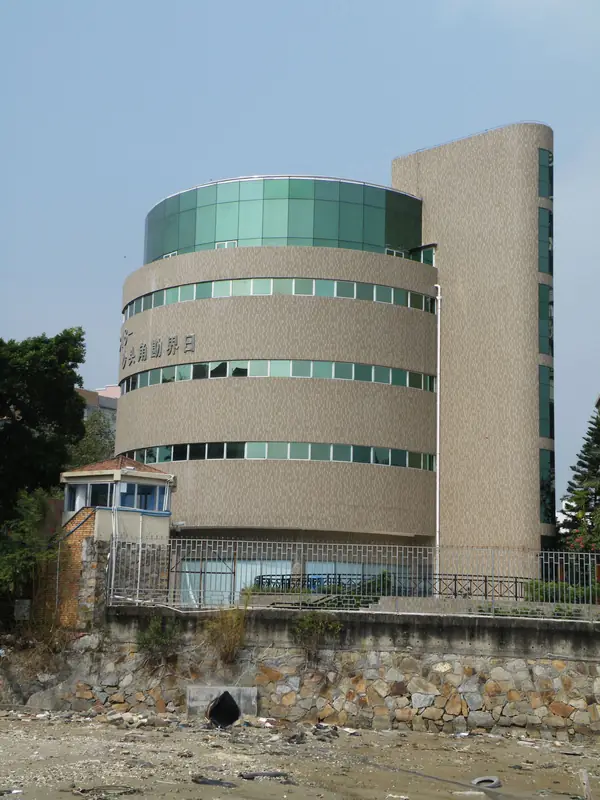
- Chung Ying Street History Museum (中英街历史博物馆), opened on 1 May 1999 and grown from a 1995 exhibition called "The Story of Chung Ying Street"
- The Warning Bell (警世钟), hung in January 2001: 1.842 m tall for the 1842 Treaty of Nanking and 1.55 tonnes for Britain's 155 years of rule in Hong Kong, with eight trapezoids on its rim standing for the eight boundary stones
- The Hong Kong checkpoint rebuilt in 2024, designed after old Sha Tau Kok branch-line stations such as Hung Leng station (孔岭站), with grey brick walls, granite plinths and wooden benches
Location & getting there
Getting to Chung Ying Street
- Search for 中英街 with 深圳市 and 盐田区.
Find Chung Ying Street
中英街 · 盐田区
No reliable map pin yet: search by the Chinese name.
Sources & visit information
Written from the linked sources and checked sentence by sentence against quoted extracts by a separate reviewer on 2026-09-23. Opening hours, admission and access arrangements are not covered; confirm current visitor information with the site.
- 中英街 - 维基百科,自由的百科全书 ↗
- Chung Ying Street - Wikipedia ↗
- 2019-时间走廊-深圳盐田政府在线-深圳市盐田区政府门户网站 ↗
- 1999-时间走廊-深圳盐田政府在线-深圳市盐田区政府门户网站 ↗
- 2002-时间走廊-深圳盐田政府在线-深圳市盐田区政府门户网站 ↗
Some facts checked against Wikipedia contributors, "中英街" · CC BY-SA 4.0.
Some facts checked against Wikipedia contributors, "Chung Ying Street" · CC BY-SA 4.0.