

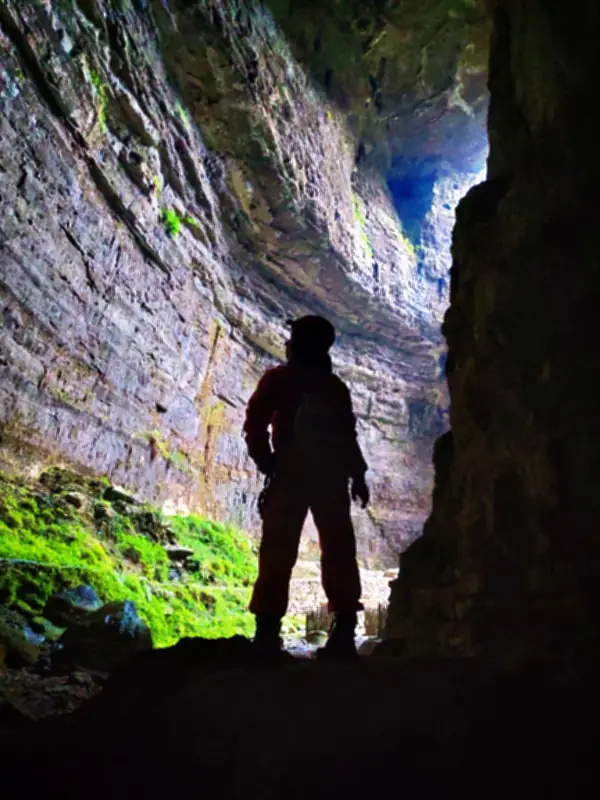
Photo adjustments
EXIF orientation normalized; resized without changing aspect ratio; converted to WebP. No subject edits.
Explore the region
About Shuanghe Cave
Shuanghe Cave (双河洞) is a cave system in Wenquan town (温泉镇) in Suiyang County (绥阳县), Zunyi (遵义), Guizhou, in the Dalou Mountains (大娄山). Its name, "two rivers", comes from the pair of streams that join outside it at Tonggu village (铜鼓村).
The cave formed in Cambrian dolomite with gypsum-bearing beds, and Chinese Wikipedia describes it as the longest dolomite cave in the world. Results of the 24th international expedition, announced in October 2025, put its total length at 439.7 km with 115 entrances, which Xinhua and People's Daily report as the longest in Asia and third in the world. The passages lie on three levels joined by shafts and cliffs: the upper and middle levels are dry, abandoned drainage routes that have become large halls and galleries, usually 10 to 20 m wide, while the lowest level carries five main underground rivers that flow all year. Calcite, aragonite, gypsum and celestite deposits line parts of the system.
Before modern scientific surveys, villagers went into some of its side passages to collect saltpetre for gunpowder and dug gypsum from a "gypsum cave". The Guizhou Institute of Mountain Resources (贵州省山地资源研究所) has organised exploration here since 1988, and the October 2025 expedition brought the institute together with the Guizhou Cave Association and the French Federation of Speleology. A 2006 Sino-French survey took the mapped length past 100 km for the first time, and in 2018 expedition members used aid climbing to link the Duiwo Dong tiankeng (堆窝洞) to the main network, lifting the total beyond Clearwater Cave in Malaysia. Earlier, in March 2004, the Ministry of Land and Resources named Shuanghe a national geopark.
Cave sediments hold a late-Pleistocene fauna of giant panda and stegodon. By late 2025 expedition members had counted 52 giant pandas, mostly Ailuropoda baconi (巴氏大熊猫), along with stegodon, rhinoceros and serow. In May 2025 the French caver Jean Bottazzi (让·波塔西) found a takin skeleton in the Jinzhong Mountain (金钟山) area around the cave; that animal and a second found about 20 m away, dated to roughly 15,000 and 11,000 years ago, are reported by Xinhua as the most complete takin fossils found in China. A mass of bones with clear signs of human handling, found in one shaft, proved to be burnt bone about 1,400 years old. A blind ground beetle new to science, named the Shuanghe blind ground beetle (双河盲步甲), lives on the cave walls. In 2025 the scenic area added cave via ferrata, cave concerts, cave paddleboarding and a cliff-side café.
What to look for
- Dry upper-level halls and galleries, mostly 10 to 20 m wide and over 40 m at the widest point
- Underground rivers on the lowest level, which form waterfalls on steep drops and pools in hollows
- Gypsum and celestite deposits in the dolomite passages
- Cave via ferrata, cave paddleboarding and cave concerts, added by the scenic area in 2025
- A cliff-side café, one of the scenic area's 2025 additions
Location & getting there
Getting to Shuanghe Cave
- Search for 双河洞 with 遵义市 and 绥阳县.
Find Shuanghe Cave
双河洞 · 绥阳县
No reliable map pin yet: search by the Chinese name.
Sources & visit information
Written from the linked sources and checked sentence by sentence against quoted extracts by a separate reviewer on 2026-09-23. Opening hours, admission and access arrangements are not covered; confirm current visitor information with the site.
- 双河洞 - 维基百科,自由的百科全书 ↗
- “亚洲第一长洞”双河洞启动第24次国际洞穴科学考察-新华网 ↗
- 远古发现丨我国最完整羚牛化石现身贵州双河洞-新华网 ↗
- 又有新發現!貴州綏陽雙河洞第24次國際洞穴科考成果發布 ↗
- 贵州绥阳双河洞发现“盲步甲”新属种 ↗
Some facts checked against Wikipedia contributors, "双河洞" · CC BY-SA 4.0.