

Photo adjustments
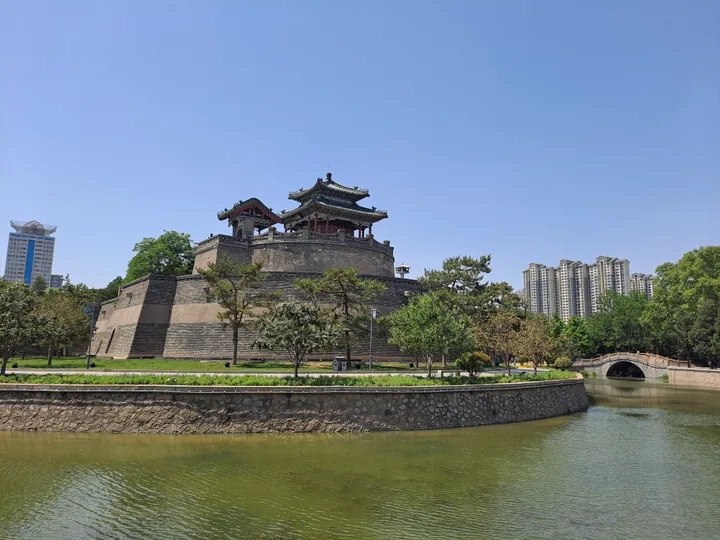
Full frame retained; proportionally resized and converted to WebP. No retouching or changes to the photographed subject. Card displays may crop the view.
Explore the region
About Congtai Park
Congtai Park (丛台公园) is a large historical park on the west side of the middle section of Zhonghua Avenue (中华大街) in Handan (邯郸), Hebei. It was laid out around Wuling Congtai (武灵丛台), a terrace traditionally dated to the Zhao state of the Warring States period.
Work on the park began in 1939 to protect the terrace, and the city government drew up a new plan for it in 1953. By 2017 the grounds covered 247,000 m², with 24,000 m² of lake and 191,000 m² of green space. It was rated an AAAA tourist attraction in 2007 and named a national key park in 2008.
Tradition holds that King Wuling of Zhao (赵武灵王), who reigned from 325 to 299 BC, built the terrace to watch song and dance and military drills. The name, literally "cluster of terraces", comes from the many platforms once joined together here. After two thousand years of damage and rebuilding, the present structure dates from the Tongzhi reign of the Qing (1862–1874), with later repairs. Hebei listed it as a provincial protected site in 1982. Tang poets Li Bai (李白), Du Fu (杜甫) and Bai Juyi (白居易) are recorded as having climbed it, and the Qing novel Erdu Mei (二度梅) is set here.
The main entrance is the east gate on Zhonghua Avenue, where a workers, peasants and soldiers statue from the Cultural Revolution stands inside. The terrace rises in three tiers to 26 m, with eight large archaic characters on its east wall; a stone outside the terrace's main gate carries lines Guo Moruo (郭沫若) wrote on climbing it in autumn 1961. Congtai Lake (丛台湖) fills the centre of the park, and its island holds the Wangzhu Pavilion (望诸榭), a hexagonal pavilion built in the Yongzheng reign by Handan magistrate Zheng Fangkun (郑方坤) in memory of the general Yue Yi (乐毅). North of the terrace, the Hall of Seven Worthies (七贤祠) honours three loyal ministers of Jin and four Zhao figures, including Lian Po (廉颇) and Lin Xiangru (蔺相如); it was moved here, facing south, when rebuilt in 1983. The northern gardens include a plum garden of more than 400 trees.
What to look for
- Wuling Congtai (武灵丛台), a three-tier, 26 m terrace, a Hebei provincial protected site since 1982
- Guo Moruo's (郭沫若) 1961 poem carved on a stone outside the terrace gate
- Wangzhu Pavilion (望诸榭), the hexagonal island pavilion on Congtai Lake built in memory of Yue Yi (乐毅)
- Hall of Seven Worthies (七贤祠), rebuilt in 1983 north of the terrace
- The stele forest west of the hall, with 44 inscribed tablets including the epitaph of the Tang military governor He Hongjing (何弘敬)
- The plum garden, with more than 400 plum trees of several kinds, one of the northern gardens along with the rose, peony and magnolia gardens
Location & getting there
Getting to Congtai Park
- Search for 丛台公园 with 邯郸市 and 丛台区.
Find Congtai Park
丛台公园 · 丛台区
No reliable map pin yet: search by the Chinese name.
Sources & visit information
Written from the linked sources and checked sentence by sentence against quoted extracts by a separate reviewer on 2026-09-23. Opening hours, admission and access arrangements are not covered; confirm current visitor information with the site.
Some facts checked against Wikipedia contributors, "丛台公园" · CC BY-SA 4.0.
Some facts checked against Wikipedia contributors, "武灵丛台" · CC BY-SA 4.0.