

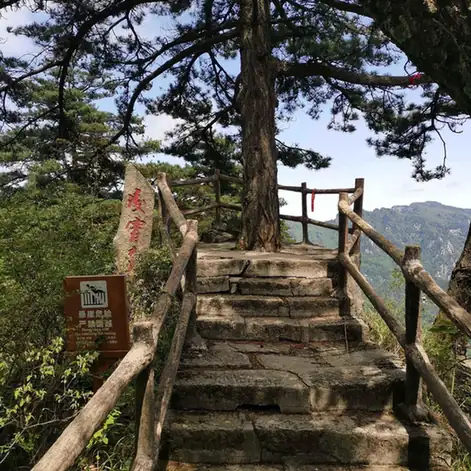
Photo adjustments
EXIF orientation normalized; resized without changing aspect ratio; converted to WebP. No subject edits.
Explore the region
About Baotianman Scenic Area
Baotianman Scenic Area (宝天曼) is a forested stretch of the Funiu Mountains (伏牛山) in the deep hills north of Xiaguan (夏馆), Neixiang County (内乡县), Nanyang (南阳), Henan. It is protected as the Henan Baotianman National Nature Reserve (河南宝天曼国家级自然保护区), which reaches across the county line into Nanzhao County (南召县).
The reserve sits on the edge where China's second topographic step drops to the third, and its ground falls away from northeast to southwest, between 360 m and 1,830 m according to UNESCO. The high Funiu ridges hold back cold northwestern winds and trap warm, humid subtropical air, so the climate here is a transition between the northern subtropics and the warm-temperate zone. The Tuan River (湍河) rises on Baotianman's northwestern summit and flows out of Neixiang into Dengzhou (邓州); further downstream it joins the Bai River (白河) and ultimately drains to the Han River (汉江).
UNESCO added Baotianman to its Man and the Biosphere Programme in 2001; the reserve covers 29,518 hectares. Baotianman National Geopark and Baotianman National Forest Park are two of the units combined with other Nanyang sites to form the Funiu Mountain Global Geopark (伏牛山世界地质公园). A local legend explains the name: the couple Dabao and Manzhu planted trees and protected wildlife on these slopes, and later generations joined their names to call the area Baotianman.
Forest covers 93.9 percent of the reserve, and 2,911 species and varieties of higher plants have been recorded there. Protected trees include ginkgo, the katsura tree (连香树) and Emmenopterys henryi (香果树), and the Henan azalea (河南杜鹃) is one of 28 ancient endemic plants. Leopards and clouded leopards are among the nationally first-class protected animals. UNESCO notes small alpine wetlands and marshes scattered through the high forest, and villagers in the buffer zone grow crops and medicinal herbs such as Fructus corni.
What to look for
- Transition-zone forest covering 93.9 percent of the reserve, with ginkgo, katsura and Emmenopterys trees
- Alpine wetlands and marshes inside the high forest, from just over 10 m² to several hundred m²
- The Henan azalea (河南杜鹃), one of 28 ancient endemic plants recorded here
- The northwestern summit where the Tuan River (湍河) rises
- Baotianman Gorge Rafting (宝天曼峡谷漂流), billed by the county as the "first drift of the Central Plains"
- Buffer-zone villages of the reserve, nine in all, living from farming and forestry
Location & getting there
Getting to Baotianman Scenic Area
- Search for 宝天曼 with 南阳市 and 内乡县.

Find Baotianman Scenic Area
宝天曼 · 内乡县
No reliable map pin yet: search by the Chinese name.
Sources & visit information
Written from the linked sources and checked sentence by sentence against quoted extracts by a separate reviewer on 2026-09-23. Opening hours, admission and access arrangements are not covered; confirm current visitor information with the site.
- 河南宝天曼国家级自然保护区 - 维基百科,自由的百科全书 ↗
- 内乡县旅游景区-内乡县人民政府 ↗
- Baotianman - Man and the Biosphere Programme (MAB) ↗
- Neixiang County - Wikipedia ↗
- 湍河 - 维基百科,自由的百科全书 ↗
- 伏牛山世界地质公园 - 维基百科,自由的百科全书 ↗
Some facts checked against Wikipedia contributors, "河南宝天曼国家级自然保护区" · CC BY-SA 4.0.
Some facts checked against Wikipedia contributors, "Neixiang County" · CC BY-SA 4.0.
Some facts checked against Wikipedia contributors, "湍河" · CC BY-SA 4.0.
Some facts checked against Wikipedia contributors, "伏牛山世界地质公园" · CC BY-SA 4.0.