

Photo adjustments
EXIF orientation normalized; resized without changing aspect ratio; converted to WebP. No subject edits.
Explore the region
About Chenjiagou Village
Chenjiagou Village (陈家沟) is the village in Zhaobao town (赵堡镇), Wen County (温县), Jiaozuo (焦作), Henan, recognised as the birthplace of taijiquan (太极拳). It stands on the Qingfeng Ridge (清风岭) 5 km east of the county town, on the north side of the Yellow River.
The village was once called Changyang (常阳村). In the Hongwu reign of the Ming dynasty a man named Chen Bu (陈卜) moved here from Zezhou (泽州) in Shanxi; a deep ravine ran north to south through the settlement, and as his descendants multiplied it took the name Chenjiagou, "Chen family ravine". The ground is older than the clan: on 8 August 2006 archaeologists found 3 to 4 m of unbroken layers left by five periods, from the Longshan culture through the Western Zhou, the Spring and Autumn and Warring States eras, to the Han. The South-to-North Water Diversion canal now crosses the village.
Chen-style taijiquan appeared in the late Ming and early Qing, created by Chen Wangting (陈王廷) of Chenjiagou. It entered China's first national list of intangible cultural heritage in 2006, nominated by Jiaozuo. In August 2007 the national martial-arts authorities, after examining competing claims, named Chenjiagou the birthplace of taijiquan, and on 17 December 2020 UNESCO inscribed taijiquan on its list of humanity's intangible heritage. The first international taijiquan annual meeting was held here on 5 September 1992, and the village is a national AAAA-rated scenic area.
The East Ravine (东沟), on the east side of the village, runs about 1.5 km, wider at the south end than the north and six to seven metres deep, thickly wooded and with two practice platforms; masters trained pupils here, and tradition places Chen Wangting's invention of the form in it. The China Taijiquan Museum presents the art's history, branches, theory and techniques in five sections and holds nearly 3,000 objects, including boxing classics and manuals.
What to look for
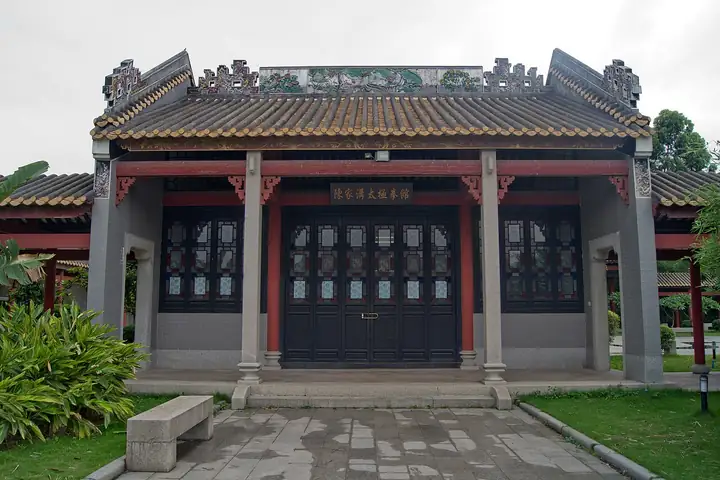
- Ancestral Hall of Taijiquan (太极拳祖祠) and the Chen family burial grove (祖林)
- East Ravine (东沟), the 1.5 km wooded gully with two practice platforms where Chen Wangting is said to have created the form
- China Taijiquan Museum (中国太极拳博物馆), described by Jiaozuo as China's first museum devoted to a single martial art
- The place where Yang Luchan learned his boxing (杨露禅学拳处)
- Chen Zhaopi Cemetery (陈照丕陵园)
- Chinese Taijiquan Culture Park (中华太极拳文化园)
- An old Chinese honey locust tree (古皂角树) among the village sights
Location & getting there
Getting to Chenjiagou Village
- Search for 陈家沟 with 焦作市 and 温县.
Find Chenjiagou Village
陈家沟 · 温县
No reliable map pin yet: search by the Chinese name.
Sources & visit information
Written from the linked sources and checked sentence by sentence against quoted extracts by a separate reviewer on 2026-09-23. Opening hours, admission and access arrangements are not covered; confirm current visitor information with the site.
Some facts checked against Wikipedia contributors, "陈家沟" · CC BY-SA 4.0.