

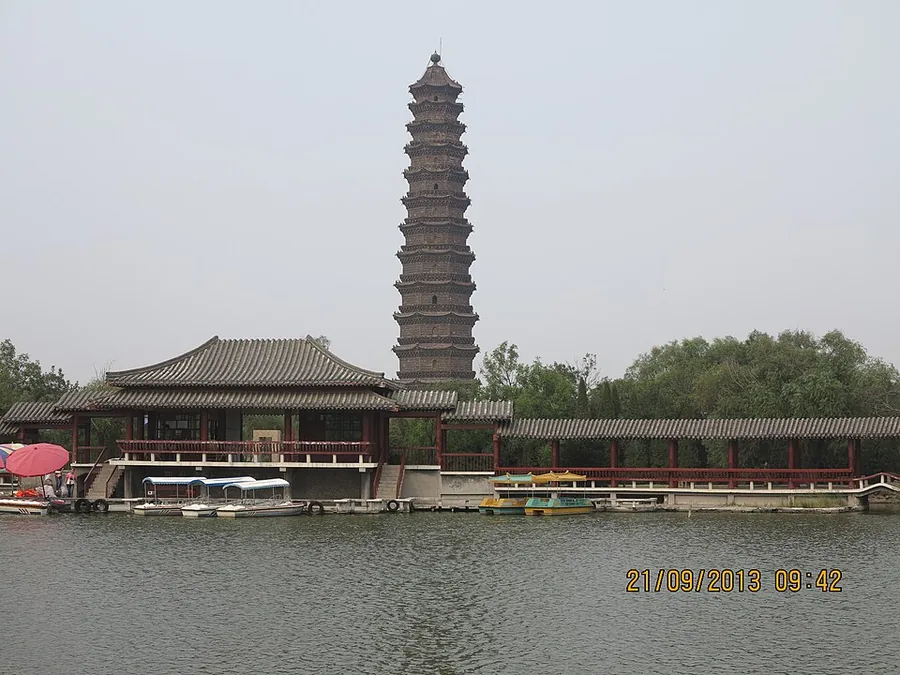
Photo adjustments
Proportionally resized and converted to WebP without cropping, retouching or changing the photographed subject.
Explore the region
About Iron Pagoda
The thirteen-storey octagonal tower dates to the Northern Song and rewards close viewing as much as a distant photograph. Its surfaces include Buddhist figures, flowers, animals and other carved motifs, while the stacked eaves emphasise its height. The surrounding temple and lake setting provides room to compare the overall silhouette with the detail of the lower levels.
The original wooden pagoda on the site was built by the architect Yu Hao between 965 and 995 as part of Youguo Temple (佑国寺) and was admired by contemporaries as a marvel before it burned down after a lightning strike in 1044. In 1847 the Yellow River overflowed its banks and the surrounding Youguo Temple collapsed, though the pagoda itself survived; it has since withstood 38 earthquakes and six floods and remains standing after nearly a thousand years.
The tower stands 56.88 metres tall in thirteen storeys on an octagonal base, with a solid brick core, an internal spiral stone staircase and openings in the walls for light and air. Its eaves are densely set with dougong brackets, and the surface uses more than fifty varieties of glazed brick bearing over 1,600 carvings, including Buddha figures, monks, musicians and dancers, flowers, lions, dragons and other mythical beasts. Under the eaves hang 104 bells that ring in the wind, and frescoes of classical tales, including Journey to the West, decorate the interior. The pagoda's foundation rests in silt deposited by the Yellow River.
What to look for
- The octagonal tower and closely stacked eaves of its thirteen storeys.
- Glazed-brick reliefs with Buddhist figures, flowers and animals.
Background & history
The Iron Pagoda (Chinese: 鐵塔) of Youguo Temple (佑國寺), Kaifeng City, Henan province, is a Chinese pagoda built in 1049. Unlike the Yu Quan pagoda of Dangang, the Iron pagoda is so-named not because it is made of iron, but because its color resembles that of iron. It is a brick pagoda tower built on the location of a previous wooden one that had been burnt down by lightning fire in 1044. Along with the Liuhe, Lingxiao, Liaodi, Pizhi, and Beisi pagodas, it is seen as a masterpiece of Song dynasty architecture. The Iron Pagoda is often confused with the Yu Quan Pagoda of Dangyang, which is the pagoda that is almost entirely made out of cast iron.
Excerpt from Wikipedia: Iron Pagoda · Wikipedia contributors · CC BY-SA 4.0. Selected introductory sentences; formatting simplified. Background information, not current visitor-service advice.
The surrounding area
A provincial city base for food traditions and a Gulou-area evening.
Location & getting there
Getting to Iron Pagoda
Approach Iron Pagoda Park from the northern end of Jiefang Road in Kaifeng. The tower stands within the park area; plan to view the exterior and check locally whether any interior route is open.
Combine your visit
A suggested sequence linking the specific features of this visit.
-
Pagoda exterior
First take in the tower’s octagonal form and vertical rhythm.
-
Lower glazed reliefs
Move closer along the permitted path to compare the decorative figures.
-
Park lake
Finish with a more distant view of the tower in its landscape.
This order is editorial. Confirm access and any transfers between stops; it does not establish a walking route, same-day connection or common admission ticket.
Find Iron Pagoda
铁塔 · 开封市
The pin marks the area, not the entrance.
More places nearby
Approximate straight-line distances between map pins, not travel distances.
Dragon Pavilion 龙亭
2 km awayDragon Pavilion stands on a high brick platform above the lakes of northern central Kaifeng. The visible hall belongs to the later history of a site occupied by earlier palaces; it should not be read as an intact Northern Song…
View guide →Millennium City Park 清明上河园
3 km awayQingming Riverside Garden is a modern recreation inspired by Zhang Zeduan’s painting of urban life along a river. The artificial waterway links market streets, bridges and performance areas, with Rainbow Bridge forming a central…
View guide →Kaifeng 开封
3 km awayKaifeng’s former capital status is visible through a mixture of surviving monuments and later recreations. The Song-period Iron Pagoda provides an architectural anchor, while Daxiangguo Temple and the raised Dragon Pavilion…
View guide →Sources & visit information
The sources below support the place-specific description and arrival information. Suggested combinations are editorial planning ideas; confirm current opening, entry arrangements and transport services for your date.
Visitor information adapted and edited from Wikipedia contributors, “Iron Pagoda” · CC BY-SA 4.0. Source revision 1368259702.
Visitor information adapted and edited from Wikivoyage contributors, listing “Iron Pagoda” · CC BY-SA 4.0.
Background paragraphs condensed from Wikipedia contributors, "Iron Pagoda", English Wikipedia · CC BY-SA 4.0. Source revision 1368259702.