

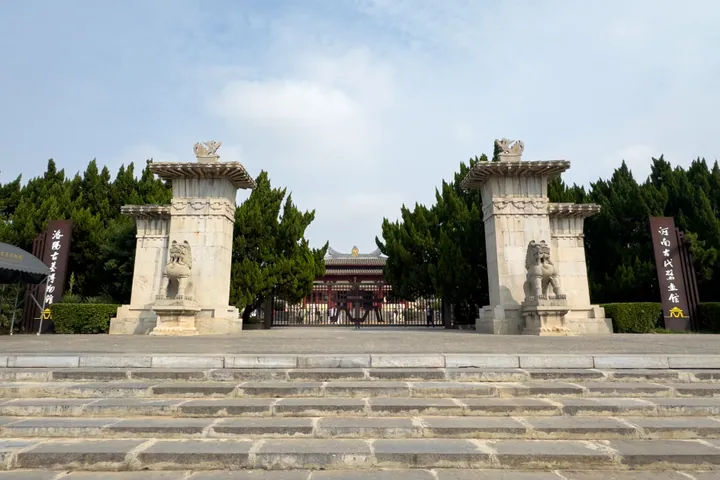
Photo adjustments
Full frame retained; proportionally resized and converted to WebP. No retouching or changes to the photographed subject. Card displays may crop the view.
Explore the region
About Luoyang Museum of Ancient Tombs
Luoyang Museum of Ancient Tombs (洛阳古墓博物馆), which also carries the name Henan Ancient Mural Museum (河南古代壁画馆), displays excavated tombs rebuilt on its grounds together with a Northern Wei emperor's tomb, on Jichang Road (机场路) in the Mangshan Subdistrict (邙山街道) of Luoyang's Laocheng District (老城区).
Construction began in 1984 and the museum opened in 1987 with 22 tombs moved from their original sites and reassembled. One more was added in 1992, a Northern Song tomb came from the area flooded by the Xiaolangdi (小浪底) reservoir in October 1996, and a Jin-dynasty tomb from near the Yellow River Grand View (黄河大观) in Zhengzhou (郑州) followed in August 1998, bringing the total to 25. The grounds cover 130 mu, with one group of buildings in Han style and another in Northern Wei style. The museum was renamed the Luoyang Ancient Art Museum in 2008 and took on the Henan Ancient Mural Museum name in 2011.
The typical-tombs display arranges the 25 tombs, from nine dynasties between the Western Han and the Jin, in date order. Nine of them hold wall paintings. The Western Han Bu Qianqiu tomb (卜千秋墓), found in 1976, has murals organised around yin-yang and the five phases, and another Western Han tomb, found in 1957, is named after its mural of ghost-beating (打鬼图). The Tang tomb of An Pu (安菩) and his wife, excavated in 1984, yielded three-colour glazed pottery and a gold coin struck in the reign of the Byzantine emperor Phocas. The Northern Song tomb of Song Silang (宋四郎) has a painted brick gatehouse imitating timber and a mural of a husband and wife drinking together.
On the west side lies Jingling (景陵), the tomb of Emperor Xuanwu of the Northern Wei. The museum and the Han-Wei Luoyang City team of the Institute of Archaeology, Chinese Academy of Social Sciences, carried out a rescue excavation there between June and August 1991, and it opened to visitors in April 1992. Jingling counts as one component of the Mangshan Mausoleum Cluster (邙山陵墓群), which entered China's sixth national list of key protected heritage sites in 2006. The mural gallery shows 65 paintings in 18 groups from Henan tombs dating from the Han to the Republican era, and a further room holds 106 carved bricks from Song and Jin tombs.
What to look for
- Bu Qianqiu tomb (卜千秋墓), a Western Han tomb with murals built around yin-yang and the five phases
- The Western Han tomb named after its ghost-beating mural (打鬼图)
- Tomb of An Pu (安菩) and his wife, a Tang tomb that yielded sancai ware and a Byzantine gold coin
- Song Silang tomb (宋四郎墓), a Northern Song brick tomb with a painted gatehouse and a mural of a couple drinking
- Jingling (景陵), the excavated tomb of Emperor Xuanwu of the Northern Wei
- Earth Palace for a Thousand Autumns (地府千秋), 65 tomb murals from across Henan
- Song and Jin carved-brick exhibition, 106 bricks on everyday life, filial piety and hopes for good fortune
Location & getting there
Getting to Luoyang Museum of Ancient Tombs
- Search for 洛阳古墓博物馆 with 洛阳市 and 老城区.
Find Luoyang Museum of Ancient Tombs
洛阳古墓博物馆 · 老城区
No reliable map pin yet: search by the Chinese name.
Sources & visit information
Written from the linked sources and checked sentence by sentence against quoted extracts by a separate reviewer on 2026-09-23. Opening hours, admission and access arrangements are not covered; confirm current visitor information with the site.
Some facts checked against Wikipedia contributors, "洛阳古墓博物馆" · CC BY-SA 4.0.