

Photo adjustments
Full frame retained; proportionally resized and converted to WebP. No retouching or changes to the photographed subject. Card displays may crop the view.
Explore the region
About Neixiang County Yamen
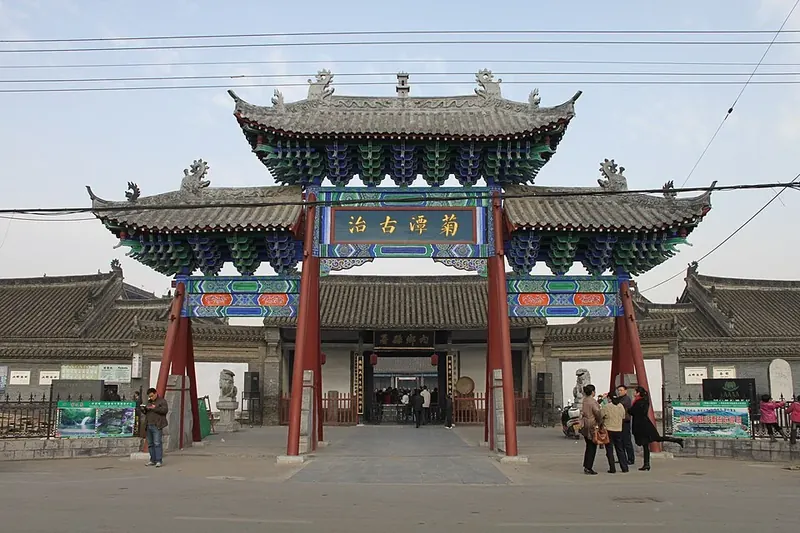
Neixiang County Yamen (内乡县衙), also called Juntan Guzhi (菊潭古治), is the former seat of county government in Neixiang County, Nanyang (南阳), Henan. The complex that stands today was rebuilt in 1894 and has been a museum since 1984.
County records date the first office halls here to 1304, under the Yuan. Magistrate Shi Weiyi (史惟一) rebuilt them in 1369 and they were repaired in 1451, lost in the turmoil of Li Zicheng's (李自成) revolt, rebuilt in the Kangxi reign and burned by the Nian (捻军) rebels in 1857. The present buildings were put up in 1894 by magistrate Zhang Bingtao (章炳焘), who raised large sums for the work. Neixiang was governed from here through the Republic, and the county government kept its offices inside until 1968. In November 1966 Red Guards from Xi'an Jiaotong University (西安交大) pulled down the landmark Xuanhua Arch (宣化坊); it was put back in 1993.
Most buildings on the two side axes are gone, and what remains is the central axis: 117 rooms on a 6,700 m² plot. The plan keeps the Qing arrangement for local offices, facing south, with civil offices on the left and military on the right, business halls ahead of the living quarters and the jail to the south. Under Zhang, a native of Shaoxing (绍兴) in Zhejiang, the complex took on a mix of building styles from north and south of the Yangtze. Five gates lead in, from the Xuanhua Arch through the main gate, ceremonial gate (仪门) and screen gate to the inner-residence gate. On the axis stand the great hall, second hall and third hall, where the magistrate held major business, pre-trial hearings and lived; each is five bays wide under a single-eave, flush-gable roof.
The museum opened in February 1984, approved by the Ministry of Culture as the only county-yamen museum in mainland China. Its 32 display rooms mostly show restored period interiors, and a re-enactment of a magistrate hearing a case is performed. The 405 objects in the collection include a trial desk said to be over 600 years old, kneeling stones for plaintiff and defendant, and colour portraits of Emperor Guangxu and of Cixi (慈禧), the Empress Dowager. A couplet hangs at the door of each main building. It has been on the national list of key protected heritage sites (全国重点文物保护单位) since 1996 and is rated a national AAAA tourist attraction.
What to look for
- Xuanhua Arch (宣化坊), where Ming and Qing magistrates read the imperial "Sacred Edict" to townspeople on the 1st and 15th of each month
- Jieshi Arch (戒石坊), a three-opening stone archway before the great hall carved "Impartiality brings clarity" (公生明)
- The Six Offices (六房) for personnel, revenue, rites, military, justice and works, staffed in the Qing by over 120 clerks
- Second hall plaque reading "Heavenly principle, state law, human feeling" (天理国法人情)
- Third hall (三堂), the magistrate's reception and living hall, with a 1680 couplet by magistrate Gao Yiyong (高以永) about officials living off the people
- Fuzi Courtyard (夫子院), the secretaries' quarters, with an exhibition on Yuan Haowen (元好问), Jin-dynasty magistrate of Neixiang from 1227
- Sanyuan Jinyue Stele (三院禁约碑), a late-Ming stone at the main gate fixing how visiting officials could be entertained by rank
- The walled jail in the southwest, with inner, outer and women's cells and a shrine to the jail god Gao Yao (皋陶)
Location & getting there
Getting to Neixiang County Yamen
- Search for 内乡县衙 with 南阳市 and 内乡县.
Find Neixiang County Yamen
内乡县衙 · 内乡县
No reliable map pin yet: search by the Chinese name.
Sources & visit information
Written from the linked sources and checked sentence by sentence against quoted extracts by a separate reviewer on 2026-09-23. Opening hours, admission and access arrangements are not covered; confirm current visitor information with the site.
Some facts checked against Wikipedia contributors, "内乡县衙" · CC BY-SA 4.0.