

Photo adjustments
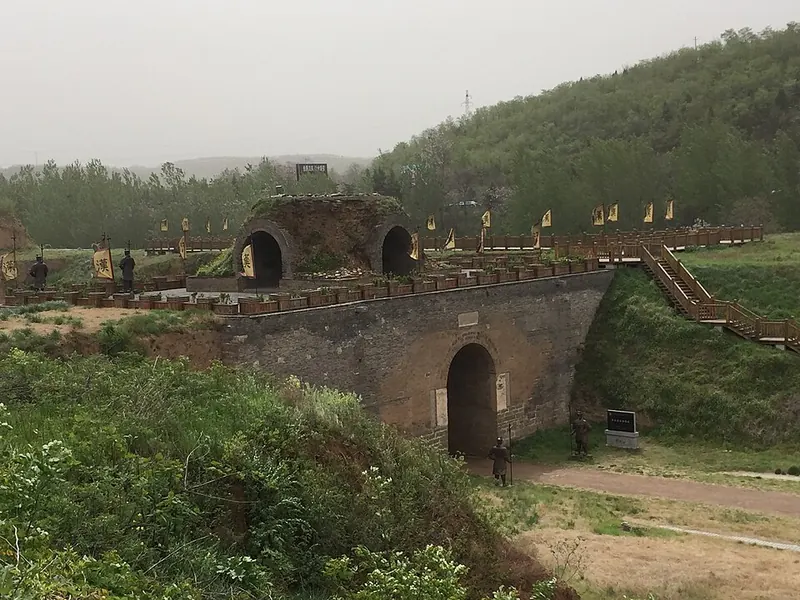
Full frame retained; proportionally resized and converted to WebP. No retouching or changes to the photographed subject. Card displays may crop the view.
Explore the region
About Hangu Pass
Its modern gate towers help visitors imagine that strategic position, while Taichu Palace reflects the tradition that Laozi composed the Tao Te Ching at the pass. Much of the visible visitor architecture was built after the site’s modern development. This Lingbao site is distinct from the Han-period Hangu Pass archaeological site near Xin’an.
The pass takes its name from the deep, box-like gorge (函) that its road passes through. The Han-dynasty essay Guo Qin Lun (过秦论) by Jia Yi cites the pass as the point where a coalition of six rival states failed to break through Qin's defenses. It is counted among the Four Great Ancient Passes of China, together with Yanmen Pass (雁门关), Xianxia Pass (仙霞关) and Jianmen Pass (剑门关).
The Western Han established a county called Hongnong (弘农) by the pass, the seat of Hongnong commandery (弘农郡). Under the Eastern Han, after Wang Mang's Xin dynasty, its fortifications guarded the capital Luoyang against attacks from the west and northwest; late in the dynasty, Dong Zhuo cited the pass's defensibility when forcing Emperor Xian to move the capital from Luoyang to Chang'an. In the Three Kingdoms period, Cao Wei built a new pass nearby, echoing the old Qin fortification. Over the next two thousand years the site continued to change hands in conflicts, including the Tang-dynasty An Lushan Rebellion and the modern War of Resistance against Japan.
What to look for
- The reconstructed gate and corridor setting, explaining the pass’s strategic role.
- Taichu Palace and the commemorative landscape associated with the Laozi tradition.
Background & history
Hangu Pass or Hanguguan was a fortified gateway that commanded the strategic mountain pass between the Yellow River and Qinling Mountains, forming the main choke point on the only land corridor between the Central Plain and the Guanzhong region. The pass restricted access into the lower Wei River valleys, where the heartland of the state of Qin and the unified Qin dynasty were located, as well as the subsequent dynasties of Han, Sui and Tang. The Hangu Pass lies on the south (right) bank of the Yellow River, 60 km (37 mi) downstream of its eastward bend out of the Ordos Loop. It was built by the state of Qin in 330 BC and had been the site of many sieges and field battles during the Warring States period and early imperial eras.
Excerpt from Wikipedia: Hangu Pass · Wikipedia contributors · CC BY-SA 4.0. Selected introductory sentences; formatting simplified. Background information, not current visitor-service advice.
Location & getting there
Getting to Hangu Pass
Travel to Wangduo Village in Hanguguan Town, Lingbao. Include Lingbao in your destination request so that you are not routed to the different Han Hangu Pass near Xin’an, east of here.
Combine your visit
A suggested sequence linking the specific features of this visit.
-
Gate and pass approach
Begin with the terrain and the defensive purpose of the corridor.
-
Taichu Palace
Compare the military story with the later Taoist commemoration.
This order is editorial. Confirm access and any transfers between stops; it does not establish a walking route, same-day connection or common admission ticket.
Find Hangu Pass
函谷关 · 三门峡市
The pin marks the area, not the entrance.
More places nearby
Approximate straight-line distances between map pins, not travel distances.
Shanzhou Silo-Cave 陕州地坑院
21 km awayAt Beiying, houses are arranged around courtyards sunk below ground level, with rooms dug into the sides of the earth. Looking down from the surface and then entering a courtyard produces two very different impressions of the…
View guide →Guo State Museum 虢国博物馆
31 km awayGuo State Museum in Sanmenxia is centred on the cemetery of a Zhou-period state. Excavated objects show the material world of its rulers, while the preserved horse-and-chariot burial turns ritual and status into a spatial…
View guide →Longtan Grand Canyon 龙潭大峡谷
106 km awayLongtan Grand Canyon cuts through purplish-red quartz sandstone in northern Xin’an County. Water has shaped narrow passages, broader basins and waterfall sections, so the changing rock walls are as significant as the water…
View guide →Sources & visit information
The sources below support the place-specific description and arrival information. Suggested combinations are editorial planning ideas; confirm current opening, entry arrangements and transport services for your date.
- en.wikipedia.org ↗
- 函谷关 ↗
- Sanmenxia ↗
- Chinese Wikipedia: 函谷关 (revision 92597182, 2026-05-09) ↗
- English Wikipedia: Hangu Pass (revision 1362433636, 2026-07-03) ↗
Visitor information adapted and edited from Wikipedia contributors, “函谷关” · CC BY-SA 4.0. Source revision 92597182.
Visitor information adapted and edited from Wikivoyage contributors, listing “Hangu Pass” · CC BY-SA 4.0.
Background paragraphs translated and condensed from Wikipedia contributors, "函谷关", Chinese Wikipedia · CC BY-SA 4.0. Source revision 92597182.
Background paragraphs condensed from Wikipedia contributors, "Hangu Pass", English Wikipedia · CC BY-SA 4.0. Source revision 1362433636.