

Photo adjustments
Full frame retained; EXIF orientation normalized, proportionally resized to at most 800 pixels and converted to WebP. No generated pixels or subject changes. Cards may crop the display.
Explore the region
About Xiangyan Temple
The temple was founded in 714 by the monk Huizhong, a disciple of the sixth Chan patriarch Huineng, who preached here for more than forty years; in 762 the emperor Daizong granted it the name Changshou Si. It once had an upper and a lower monastery about thirty li apart, but the lower one stood on the bank of the Dan River and was submerged when the Danjiang reservoir was built, so only the upper monastery remains. That upper complex occupies more than 10,000 square metres, with 4,200 square metres of building and over 140 rooms arranged in five stepped courtyards up the hillside, most of them of Ming and Qing date. It was listed as a provincial protected cultural heritage unit in 1986 and as a national key protected cultural heritage unit in 2006.
The main hall was begun in the Ming Yongle era and rebuilt under Qianlong, covers 690 square metres and is ringed by twenty-six veranda columns each seven metres high. Its walls carry 403.93 square metres of Ming Yongle painting. The east and west walls show a Chaoyuan composition of Daoist deities paying court to Yuanshi Tianzun; the north wall has an official paying homage to the Purple Bamboo Guanyin on one side and Guanyin with the Dragon Girl and Sudhana on the other. The hall was used as a school meeting room during the Cultural Revolution and the paintings were covered with limewash, which county heritage staff washed off in 1983. The murals together with the temple's wood, stone and brick carving are known locally as the three marvels and one treasure.
What to look for
- The Ming murals in the main hall, 403.93 square metres of Daoist deities in procession before Yuanshi Tianzun
- The north wall paintings of Guanyin with the Dragon Girl and Sudhana, and of an official before the Purple Bamboo Guanyin
- The main hall itself, Ming in origin and rebuilt under Qianlong, with twenty-six seven-metre veranda columns
- The stone archway at the entrance, three gates and four pillars, its lintel carved with the name Xiantong Chan Si granted in 1487
- The Wangyue Pavilion, rebuilt in 1735 and framed entirely in timber without iron nails
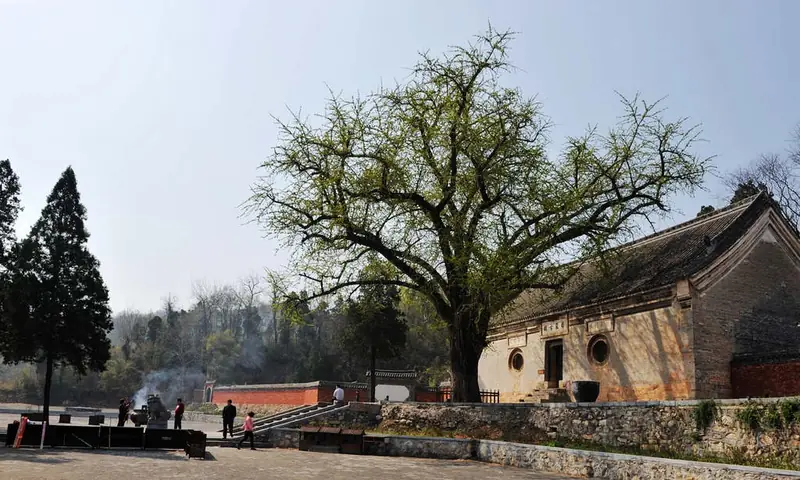
- The ginkgo more than 1,300 years old in the first courtyard, and the eighty-odd surviving stelae, mostly Ming and Qing
Location & getting there
Getting to Xiangyan Temple
Check which interiors and courtyards are accessible. Active places of worship and protected monuments may have different visitor rules.
- Search for 香严寺 with 南阳市 and 淅川县.

Find Xiangyan Temple
香严寺 · 淅川县
No reliable map pin yet: search by the Chinese name.
Sources & visit information
The linked sources support the identity and background described in this introduction. Opening hours, admission, activity availability and exact arrival arrangements have not been comprehensively checked. Confirm current visitor information with the venue; the original catalogue locality and editorial review flag are retained.