

Photo adjustments
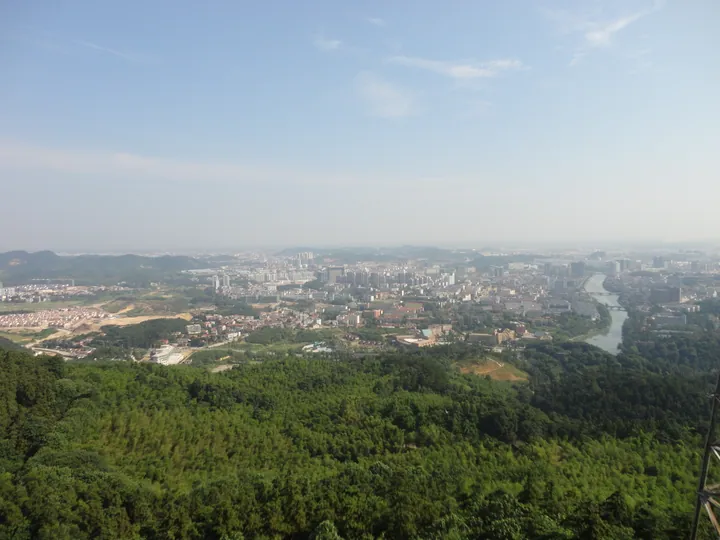
Full frame retained; proportionally resized and converted to WebP. No retouching or changes to the photographed subject. Card displays may crop the view.
Explore the region
About Qianshan National Forest Park
The hill is a spur of the Mufu Mountains, with the Gan River looping in nine bends below it, and the municipal forestry bureau describes it as the only national forest park in central China that lies inside a city centre. Forest cover across the 683 hectares is recorded at 95.6 percent, and the woodland holds 471 tree species in 70 families and 164 genera, gathering northern and southern trees on a single hill along with close to 200 kinds of flowering plants. The mean annual temperature is 16.3 degrees Celsius and mean annual humidity around 80 percent, in a subtropical monsoon climate of plentiful rain, four distinct seasons and a long frost-free period. The park is also designated a national ecological civilization education base.
Qianshan carries a long-established scheme of three terraces and eight scenes. The terraces are Guanyin Terrace, Dressing Terrace and Reading Terrace; the eight scenes run from the night view at the reading terrace and the haze over Danmu to the waterfall's sound and the wind in the pines at Gou Well, and local tradition ties them to the Northern Song statesman Feng Jing, to the alchemist Ge Hong and to Guanyin. The best known building on the hill is Qianshan Temple, founded in the Kaiyuan era of the Tang dynasty and grown by the Ming into a complex recorded as nine tiers and thirteen halls; Feng Jing under the Song and Zhu Yanli under the Ming are both said to have studied there, and Chen Huanshi, a Qing magistrate of Xianning, left a poem on the temple's past. Later reconstruction restored an ecological leisure plaza, the Zhuangyuan Pavilion, an osmanthus garden, a bamboo species garden and a botanical garden, and added an osmanthus exhibition hall and a bamboo exhibition hall as science-education displays.
What to look for
- Qianshan Temple, founded in the Kaiyuan era of the Tang dynasty and enlarged under the Ming into a complex recorded as nine tiers and thirteen halls.
- The osmanthus exhibition hall and the bamboo exhibition hall, two science-education displays built inside the park.
- The osmanthus garden and the bamboo species garden, planted collections restored on the hill.
- The three terraces of the park's old scheme of three terraces and eight scenes: Guanyin Terrace, Dressing Terrace and Reading Terrace.
- The Gan River, which winds in nine bends below the hill.
Location & getting there
Getting to Qianshan National Forest Park
Check weather, trail access and the last return service. A mountain or forest area is not one entrance, and a map’s central pin may be far from the trailhead.
- Search for 潜山国家森林公园 with 咸宁市 and 咸安区.

Find Qianshan National Forest Park
潜山国家森林公园 · 咸安区
No reliable map pin yet: search by the Chinese name.
Sources & visit information
The linked sources support the identity and background described in this introduction. Opening hours, admission, activity availability and exact arrival arrangements have not been comprehensively checked. Confirm current visitor information with the venue; the original catalogue locality and editorial review flag are retained.