

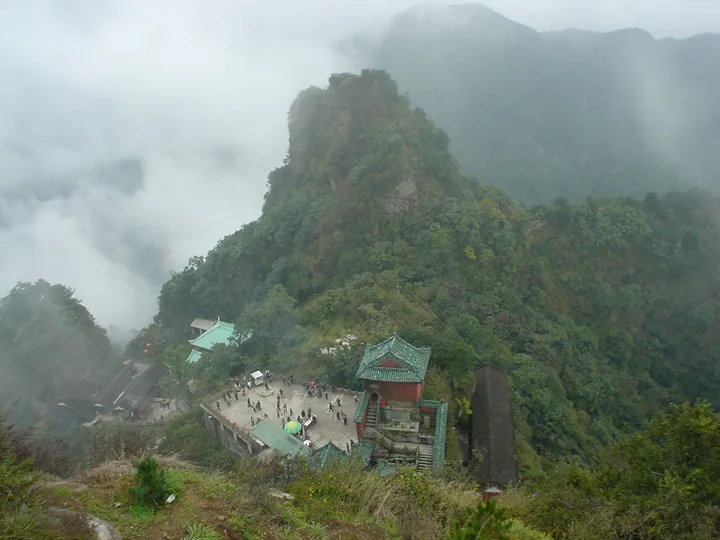
Photo adjustments
Full frame retained; proportionally resized and converted to WebP. No retouching or changes to the photographed subject. Card displays may crop the view.
Explore the region
About Wudang Mountains
The Wudang Mountains (武当山) are a Daoist holy range south of the Han River (汉江) in Danjiangkou (丹江口市), Shiyan (十堰), in northwestern Hubei. Their Daoist palaces and temples, the largest group of them built under the Ming Yongle Emperor, were inscribed as a World Heritage Site in 1994.
The range is an eastern offshoot of the Daba Mountains (大巴山). It stretches over 260 km from the Hubei–Shaanxi border to south of Xiangyang (襄阳), looking across the Han to Dahong Mountain (大洪山). The name also applies more narrowly to the cluster of peaks in Danjiangkou that forms the Daoist centre; the Wudang Mountain scenic area covers 312 km². The mountain is described as having 72 peaks, 36 cliffs and 24 ravines; the highest, Tianzhu Peak (天柱峰), stands 1,612 m above sea level. Wudang became a national geopark in August 2009.
Wudang County, created in 202 BC, took its name from the mountain. In the Zhenguan reign (627) Emperor Taizong of Tang ordered the Five Dragons Shrine (五龙祠) built after a prayer for rain here was answered. The great campaign came in 1412, when the Yongle Emperor sent more than 200,000 soldiers, civilians and craftsmen; by 1423 thirty-three palaces and temples stood finished, and a saying paired this work with the building of the Forbidden City in Beijing. In 1967 the rising Danjiangkou Reservoir (丹江口水库) drowned roughly a third of the complex, together with the old walled town of Junzhou (均州) and Jingle Palace (净乐宫), which was rebuilt as a copy on the eastern edge of Danjiangkou city in 2006. Fifty-three historic buildings and nine building sites remain.
According to the national intangible heritage list, complete sets of ritual music, including the daily morning and evening services, are still handed down in the Wudang palaces. That temple music (武当山宫观道乐) and Wudang martial arts (武当武术) were both entered on the first national list in 2006. The list credits the martial arts to Zhang Sanfeng (张三丰), a Daoist of the late Yuan and early Ming, and names tai chi, xingyiquan and baguazhang as their core forms.
What to look for
- Golden Hall (金殿) on the summit of Tianzhu Peak, a bronze building that imitates timber framing, within Taihe Palace (太和宫), built in 1416
- Zixiao Palace (紫霄宫) below Zhanqi Peak (展旗峰), laid out to imperial building rules and home of the Wudang Daoist Association
- Nanyan (南岩), facing the Golden Summit, where a Yuan-dynasty stone hall is set into the cliff face
- Xuanyue Gate (玄岳门), the stone archway inscribed "Zhishi Xuanyue" (治世玄岳), built by imperial order in 1552
- Yuxu Palace (玉虚宫) at the northern foot, begun in 1412, then the largest palace on the mountain, and restored between 2007 and 2012
- Taizi Slope (太子坡), a temple with a single pillar carrying twelve beams and a winding wall called the Nine-Bend Yellow River Wall (九曲黄河墙)
- Tianjin Bridge (天津桥) by Longquan Temple (龙泉观), the longest stone bridge on the old pilgrim path
Location & getting there
Getting to Wudang Mountains
- Search for 武当山 with 十堰市 and 丹江口市.
Find Wudang Mountains
武当山 · 丹江口市
No reliable map pin yet: search by the Chinese name.
Sources & visit information
Written from the linked sources and checked sentence by sentence against quoted extracts by a separate reviewer on 2026-09-23. Opening hours, admission and access arrangements are not covered; confirm current visitor information with the site.
- 武当山 - 维基百科,自由的百科全书 ↗
- Wudang Mountains - Wikipedia ↗
- 武当武术 - 中国非物质文化遗产网·中国非物质文化遗产数字博物馆 - 中国非物质文化遗产网非遗 ↗
- 武当山宫观道乐 - 中国非物质文化遗产网·中国非物质文化遗产数字博物馆 - 中国非物质文化遗产网非遗 ↗
Some facts checked against Wikipedia contributors, "武当山" · CC BY-SA 4.0.
Some facts checked against Wikipedia contributors, "Wudang Mountains" · CC BY-SA 4.0.