

Photo adjustments
The exact downloaded source bytes are separately retained and hashed. Prepared JPEG is proportionally reduced to a maximum 720-pixel long edge; full frame retained, no subject alteration. Final website rendition: full frame retained, proportionally resized to at most 720 pixels and converted to WebP. No additional retouching or subject alteration. Card displays may crop the view.
Explore the region
About Three Visitors Cave and Park
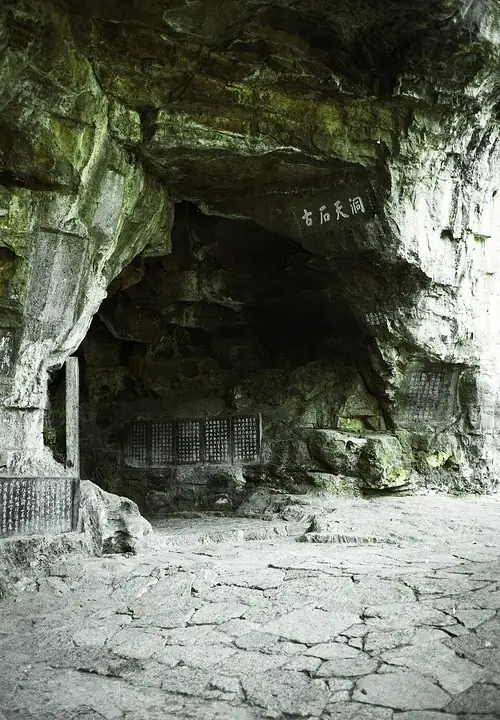
Its name recalls the visit associated with Bai Juyi, Bai Xingjian and Yuan Zhen, whose poetry helped turn this Xiling Gorge setting into a cultural landmark. Carved inscriptions give the cave its main interest; above it, Zhixi Pavilion opens the view towards the Yangtze. The combination works best as a cave-and-hillside visit, with time for the stepped paths rather than expecting a large underground cavern tour.
Before the Tang dynasty the cave was an unnamed karst hollow, taking its present name after two visits: in 819 the poets Bai Juyi (白居易), Bai Xingjian (白行简) and Yuan Zhen (元稹) toured it together at Yiling and jointly composed a twenty-rhyme poem, written on the rock face, and Bai Juyi wrote a preface naming it 'Sanyou Dong' (三游洞). In 1056 the father and sons Su Xun (苏洵), Su Shi (苏轼) and Su Zhe (苏辙) likewise visited and each carved a poem on its wall, an episode later called the 'Later Three Visitors'.
The cave is small and roughly rectangular, about 30 metres long, 9 to 10 metres wide and about 10 metres high, formed in Cambrian-era limestone some 600 million years old. Three stalactites divide its main chamber into front and back sections. Its walls carry more than fifty inscriptions, including a Song-dynasty inscription by Ouyang Xiu (欧阳修) and Bai Juyi's 'Sanyou Dong Xu' preface, re-carved in the Ming dynasty. Stone statues of Bai Xingjian, Bai Juyi and Yuan Zhen stand at its centre.
The site was first protected in 1956 as 'Sanyou Cave and its inscriptions' (三游洞其及碑刻), a first-batch Hubei provincial cultural relics protection unit, and was listed nationally in 2006 as 'Sanyou Dong Moya' (三游洞摩崖), a Major Historical and Cultural Site Protected at the National Level (全国重点文物保护单位).
What to look for
- The cave’s literary inscriptions and three-poet association.
- Zhixi Pavilion’s view towards the Xiling Gorge river landscape.
The surrounding area
A base for the Three Gorges landscape and Three-Gorges Tribe; confirm the actual boat boarding point and transfer.
Location & getting there
Getting to Three Visitors Cave and Park
Use No 8 Nanjinguan Road in Yichang. Follow the designated Sanyou Cave entrance and allow for the stepped route between the chamber and the higher pavilion; the site is distinct from other Nanjinguan canyon attractions.
Combine your visit
A suggested order for exploring this place and its immediate setting.
-
Sanyou Cave三游洞
Read the inscriptions and the story behind the name.
-
Hillside path洞旁山径
Follow the open stepped connection above the cave.
-
Zhixi Pavilion至喜亭
Finish with a wider river-and-gorge perspective.
Check access to the individual stops. A suggested sequence does not imply a combined ticket or guaranteed transfer.
Find Three Visitors Cave and Park
三游洞 · 宜昌市
The pin marks the area, not the entrance.
More places nearby
Approximate straight-line distances between map pins, not travel distances.
Three Gorges Tribe 三峡人家
11 km awayThree Gorges Tribe combines Xiling Gorge scenery with a staged presentation of local river and hill life. Longjin Stream brings bridges, boats and waterside houses into a sheltered valley, while the higher Bawangzhai area offers…
View guide →Yichang Museum 宜昌博物馆
18 km awayYichang Museum explains the Three Gorges region through archaeology, urban history and everyday material culture. The Ancient Xiling section starts with early human settlement, while Ba–Chu interpretation places the city between…
View guide →Three Gorges Waterfall 三峡大瀑布
21 km awayThree Gorges Waterfall is an inland gorge walk in Yiling, separate from the Yangtze dam and cruise route. Smaller cascades, rock walls and wooded stream sections lead towards the main fall. Its best-known close-up experience…
View guide →Sources & visit information
The sources below support the place-specific description and arrival information. Suggested combinations are editorial planning ideas; confirm current opening, entry arrangements and transport services for your date.
- Yichang government — literary history, pavilion and address ↗
- Chinese Wikipedia: 三游洞摩崖 (revision 94224431, 2026-09-07) ↗
Background paragraphs translated and condensed from Wikipedia contributors, "三游洞摩崖", Chinese Wikipedia · CC BY-SA 4.0. Source revision 94224431.