

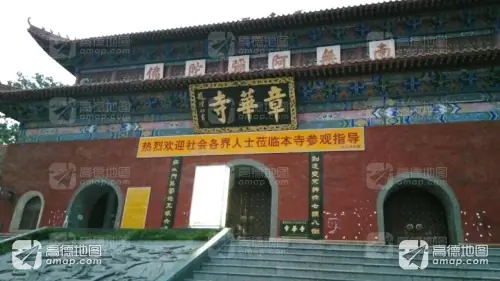
Photo adjustments
EXIF orientation normalized; resized without changing aspect ratio; converted to WebP. No subject edits.
Explore the region
About Zhanghua Temple
The Zhanghua Terrace was built in 537 BC as a detached palace by the Chu king whose reign is dated 540 to 528 BC. Li Daoyuan's Shui Jing Zhu, written under the Northern Wei, records it as ten zhang high on a base fifteen zhang wide, and because a climber needed several rests on the way up it was known as the Three Rests Terrace. It carried a second name, the Slender Waist Palace, from the Chu king's documented preference for slender dancers. The palace was long gone by the time the monk Wukai founded a temple on the site in 1325, the second year of the Yuan Taiding reign; it was first called Zhangtai Temple and was renamed Zhanghua Temple in the early Ming, around 1368. In 1388 Zhu Zhen, Prince of Chu and a son of the Ming founder, paid for its restoration.
The temple's high point came late. In 1905 the Qing court granted it a copy of the Dragon Canon together with ceremonial regalia, conferred a fourth-rank monastic title on the abbot Jingyue, and ordered a scripture library built and the main hall, the Heavenly Kings hall and the Weituo hall repaired; the temple then covered 85 mu and its community reached more than 300 monks. In 1956 it was listed among Hubei's first batch of provincial key cultural relics protection units. Its images, relics and halls were destroyed and its community dispersed during the Cultural Revolution from 1966. From 14 June 1988 the abbot Kuanlian led a rebuilding that repaired two halls and put up six halls, six chambers and monks' quarters totalling more than 18,000 square metres, with more than 200 new images installed, so most of what stands today is late 20th-century work on an old site.
What to look for
- The main hall, the Heavenly Kings hall and the Weituo hall, the three halls named in the 1905 imperial repair order
- The scripture library, built under the same 1905 order to house the Dragon Canon granted by the Qing court
- The Thousand Buddha Peace Pagoda on the temple's newer central axis
- The ground itself, identified in local record as the site of the Chu Zhanghua Terrace, the Three Rests Terrace of the Shui Jing Zhu
Location & getting there
Getting to Zhanghua Temple
Check which interiors and courtyards are accessible. Active places of worship and protected monuments may have different visitor rules.
- Search for 章华寺 with 荆州市 and 沙市区.
Find Zhanghua Temple
章华寺 · 沙市区
No reliable map pin yet: search by the Chinese name.
Sources & visit information
The linked sources support the identity and background described in this introduction. Opening hours, admission, activity availability and exact arrival arrangements have not been comprehensively checked. Confirm current visitor information with the venue; the original catalogue locality and editorial review flag are retained.