

Photo adjustments
EXIF orientation normalized; resized without changing aspect ratio; converted to WebP. No subject edits.
Explore the region
About Jiashan Temple
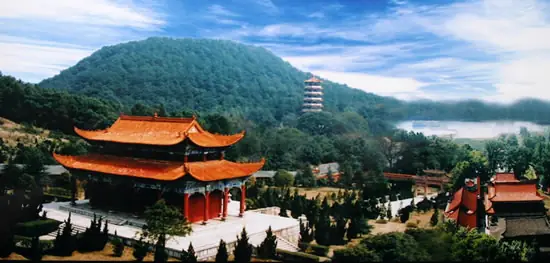
Jiashan Temple (夹山寺) is a Chan Buddhist monastery inside Jiashan National Forest Park (夹山国家森林公园), in the east of Shimen County (石门县), Changde (常德), Hunan.
The name describes the site: two hills close in on it, with a single path running between them. The monk Shanhui (善会), a pupil of Chuanzi Decheng (船子德诚) in the fourth generation of the Qingyuan Xingsi (青原行思) line, founded it in 870 under the Tang dynasty as Puci Temple (普慈寺); from the Song to the Qing it was usually called Lingquan Chan Monastery (灵泉禅院). Under the Northern Song, Yuanwu Keqin (圆悟克勤) lectured at the temple; he is the author of the Blue Cliff Record (碧岩录), praised as the foremost book of the Chan school. In the Southern Song the Japanese monk Eisai (荣西) took the book to Japan, along with Yuanwu's calligraphy of the phrase "tea and Chan share one taste" (茶禅一味).
Most of the old buildings were pulled down or altered in political campaigns after 1949, and in 1958 the temple served as the office of a state forest farm. In 1980 Shimen heritage workers found the tomb of a monk called Fengtian (奉天大和尚) nearby and argued that he was Li Zicheng (李自成), the late-Ming peasant rebel leader said to have lived here in hiding as a monk; many scholars doubt the claim. The temple became a place of worship again in 1990, and in 1992 the county government rebuilt it, together with the adjoining Chuangwang Mausoleum (闯王陵园), following the description left by He Lin (何璘), a Qing prefect of Lizhou. Hunan listed the temple as a provincial protected site in 1959 and 1983, and in 2013 the State Council placed it in the seventh batch of nationally protected heritage sites (全国重点文物保护单位).
Only the Guanyin Hall (观音殿) predates the 1992 rebuilding. It is the former Mahavira Hall, repaired in 1850: a brick-and-timber building roofed in yellow glazed tiles with double eaves, 27 metres across its seven bays, 17 metres deep and 13 metres high, whose inner columns stand on inverted-bowl bases left from the Tang and Song. Its 20 original statues and a Song bronze bell were destroyed. The rebuilt complex has a gate, the Nine-Bend Bridge (九曲桥), bell and drum towers, the Hall of the Heavenly Kings, a Dharma hall, a sutra library and the Lingquan Pagoda (灵泉塔), and Biyan Lake (碧岩湖) lies beside the temple.
What to look for
- Guanyin Hall (观音殿), the old Mahavira Hall repaired in 1850 and the only building older than 1992
- Stone tablets of 1705 and 1850 recording repairs to the Lingquan temple
- Lingquan Pagoda (灵泉塔) and the Nine-Bend Bridge (九曲桥)
- Chuangwang Mausoleum (闯王陵园), tied to the tradition that Li Zicheng lived here as a monk
- Biyan Lake (碧岩湖) beside the temple
Location & getting there
Getting to Jiashan Temple
- Search for 夹山寺 with 常德市 and 石门县.
Find Jiashan Temple
夹山寺 · 石门县
No reliable map pin yet: search by the Chinese name.
Sources & visit information
Written from the linked sources and checked sentence by sentence against quoted extracts by a separate reviewer on 2026-09-23. Opening hours, admission and access arrangements are not covered; confirm current visitor information with the site.
Some facts checked against Wikipedia contributors, "夹山寺" · CC BY-SA 4.0.
Some facts checked against Wikipedia contributors, "石门县" · CC BY-SA 4.0.