

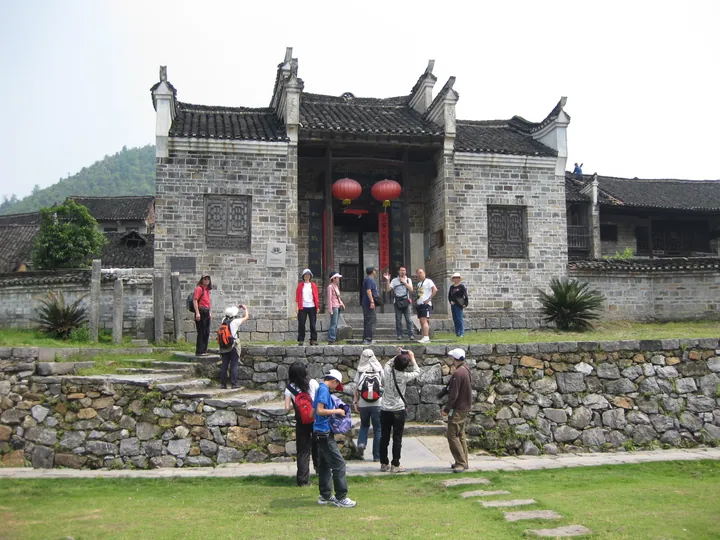
Photo adjustments
Full frame retained; proportionally resized and converted to WebP. No retouching or changes to the photographed subject. Card displays may crop the view.
Explore the region
About Yangshan Old Village
The village takes its name from Qitianling, the ridge behind it, which was anciently called Yangshan. The traditional-village record dates its founding to the Hongzhi era of the Ming, given as 1497, says it took its present shape in the Kangxi and Qianlong reigns and was at its most prosperous under Daoguang, and describes more than six hundred years of unbroken lineage settlement. The family genealogy traces the line to He Chen, a native of Nanchang in Jiangxi who took the jinshi degree in the Yuan Dade period in 1297 and served as tongpan of Liuzhou before settling in Guiyang town; his seventh-generation descendant He Tianlu moved out to Yangshan, also called Liaojiawan, in the Jiajing reign, and the family have called themselves Hakka since.
The houses stand on flat ground between two hill feet near the old post road from Hunan down to Guangzhou, with a small river and a clear pond in front and a stream running through the settlement. The layout follows Confucian ideas of balance, and the record stresses that Yangshan differs from other old villages in the county in having been founded by neither officials nor merchants but by scholars: the village produced more than ten holders of the jinshi and juren degrees, and some of its men reached the rank of general or entered the Hanlin Academy. Inscribed boards and couplets survive on the buildings, among them Jingyandi and Xuehai yuanyuan.
A gazetteer of the village, Yangshan cunzhi, was published in January 2025 after seven years of compilation; it belongs to the sixth batch of the China Famous Village Gazetteers and was the first book from Chenzhou to enter that programme.
What to look for
- The He ancestral hall, the focus of the single-lineage village
- The Jingyandi and Xuehai buildings, named for the family's scholarly tradition
- The Meige and Baitai buildings among the sixty-odd surviving old houses
- Taiji Square at the village entrance
- The stream that runs through the village, the pond in front of it and the hillside siting that the village plan follows
Location & getting there
Getting to Yangshan Old Village
Identify the main visitor approach and any separately managed houses, museums or performances. Ask before entering residential spaces or photographing residents.
- Search for 阳山古村 with 郴州市 and 桂阳县.
Find Yangshan Old Village
阳山古村 · 桂阳县
No reliable map pin yet: search by the Chinese name.
Sources & visit information
The linked sources support the identity and background described in this introduction. Opening hours, admission, activity availability and exact arrival arrangements have not been comprehensively checked. Confirm current visitor information with the venue; the original catalogue locality and editorial review flag are retained.