

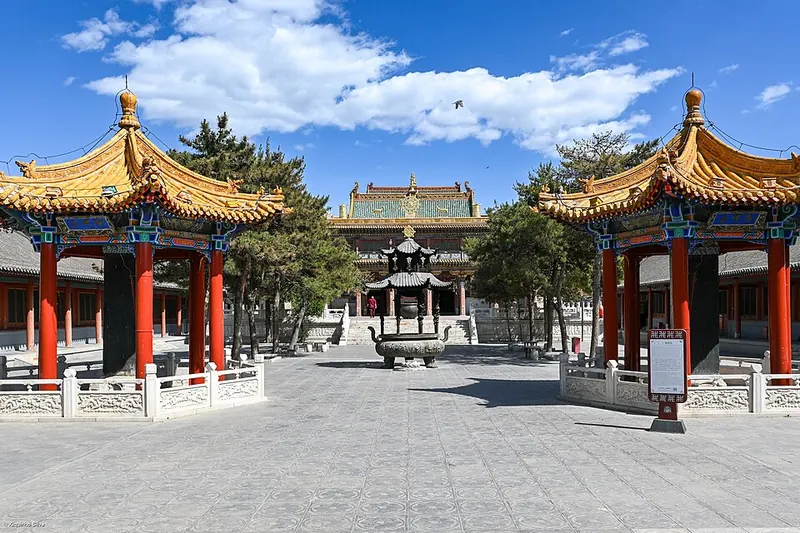
Photo adjustments
Full frame retained; proportionally resized and converted to WebP. No retouching or changes to the photographed subject. Card displays may crop the view.
Explore the region
About Xilitu Temple
The older Buddha hall preserves the memory of its early foundation, while the larger main hall reflects later expansion. A longevity stupa and bronze elephants add distinct forms to the courtyards. Its position on Shitou Lane, close to Dazhao, makes it useful for comparing two temple compounds without turning the visit into a long cross-city journey.
Xilitu Temple was built during the Longqing and Wanli eras of the Ming dynasty (1567-1619), beginning as a small temple called Old Buddha Temple (古佛寺), built by Sengge Dugureng (僧格都古楞), a son of Altan Khan. Following the will of the 3rd Dalai Lama, the temple's first Living Buddha occupied his seat, and the 4th Dalai Lama held his enthronement ceremony here, after which the temple took the name Xilitu Zhao, Mongolian for “chief” or “throne”. In 1696 the Kangxi Emperor attended a sutra-chanting ceremony there and, after its renovation, bestowed the name Yanshou Temple (延寿寺).
The temple has served as the official residence of a Living Buddha since 1735 and today houses the eleventh Grand Living Buddha. It sustained damage during the Cultural Revolution (1966-1976) but has since been restored and remains an active place of worship for Mongol monks and their disciples. It also oversees subordinate temples, including Qiao'erqi Zhao (巧尔齐召) and Wusutu North Zhao (乌素图北召), both built in Hohhot during the Kangxi era, and Xilamuren Zhao (希拉穆仁召) in present-day Damao Banner, built in the Qianlong era as the Xilitu Living Buddha's summer residence.
What to look for
- The main hall and the older Buddha hall within the temple compound.
- The longevity stupa and bronze elephant sculptures.
The surrounding area
Autonomous-region capital and urban base for temple streets, museums and local breakfast traditions.
Location & getting there
Getting to Xilitu Temple
Use the temple gate at the northern end of Shitou Lane in Yuquan District, near Dazhao.
- Check access to individual shrines at the gate and follow the active temple's photography rules.
Combine your visit
Suggested order within this visit:
-
Entrance and main hall
Start with the main architectural sequence.
-
Old Buddha hall area
Compare the earlier and later parts of the temple.
-
Longevity stupa
Finish with the compound's distinctive freestanding monument.
This sequence is an editorial suggestion based on the features described in the sources. Access to individual buildings or areas should be checked locally; no travel time or shared admission is implied.
Find Xilitu Temple
席力图召 · 呼和浩特
The pin marks the area, not the entrance.
More places nearby
Approximate straight-line distances between map pins, not travel distances.
Dazhao Temple 大召寺
Less than 1 km awayDazhao anchors the temple quarter of old Hohhot. Its main hall combines Chinese and Tibetan building forms and preserves a celebrated silver image of Shakyamuni. Golden dragons coil around the columns in front of the image…
View guide →Saishang Old Street 塞上老街
Less than 1 km awaySaishang Old Street runs west from Dazhao through Hohhot's historic trading quarter. Brick-and-timber shopfronts recall the period when goods from the grasslands met tea, silk and other products from farther south. Today's shops…
View guide →Five Pagoda Temple 五塔寺
Less than 1 km awayFive Pagoda Temple takes its name from the five small towers rising from a single diamond-throne base. Rows of individually varied Buddha images cover the masonry, making close observation as rewarding as the overall silhouette…
View guide →Sources & visit information
The linked encyclopedia sources support background and place descriptions. Current opening hours, ticket prices, booking rules and transport schedules have not been independently verified for this guide. Confirm them with the venue or operator before travelling.
Visitor information adapted and edited from Wikipedia contributors · CC BY-SA 4.0. Source revision 93285129.
Background paragraphs translated and condensed from Wikipedia contributors, "席力圖召", Chinese Wikipedia · CC BY-SA 4.0. Source revision 93285129.
Background paragraphs condensed from Wikipedia contributors, "Xilitu Zhao", English Wikipedia · CC BY-SA 4.0. Source revision 1363766581.