

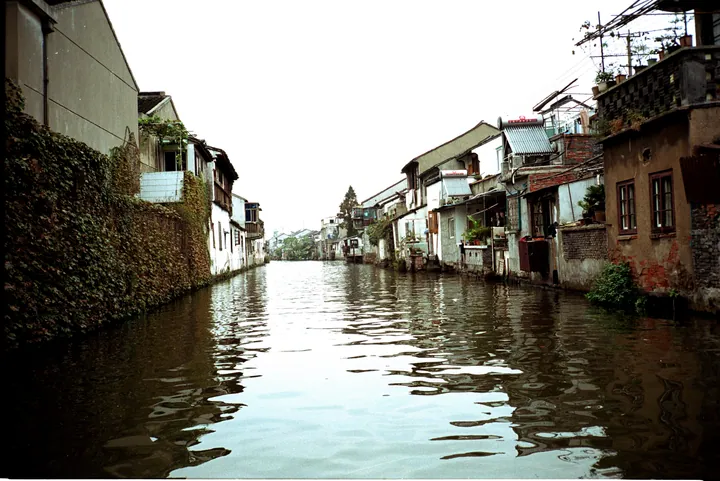
Photo adjustments
Full frame retained; proportionally resized and converted to WebP. No retouching or changes to the photographed subject. Card displays may crop the view.
Explore the region
About Shantang Street
Shantang Street (山塘街), often called Qili Shantang (七里山塘, "Seven-li Shantang"), is a pedestrian street in the northwest of Gusu District (姑苏区), Suzhou (苏州). It follows the Shantang River (山塘河) for 3,829.6 m, from Xichang Lane (席场弄) below Tiger Hill (虎丘) to Duseng Bridge (渡僧桥) outside Changmen Gate (阊门).
The river and street date from 825, when the Tang poet Bai Juyi (白居易), newly moved from Hangzhou to govern Suzhou, had a waterway cut between Tiger Hill and Changmen to ease travel by boat and on foot. Earth dug from the channel formed a bank on its northern side, known as Baigong Dam (白公堤) after him, and the street was laid along it. Houses here typically front the street and back onto the water.
The Qianlong Emperor came in 1762 on a southern tour and wrote the phrase "Shantang xunsheng" (山塘寻胜, "seeking fine views at Shantang"); the pavilion sheltering his inscribed stele still stands. Back in Beijing he had a Suzhou Street modelled on it built by the rear lake of the Summer Palace. In 1860 Taiping forces under Li Xiucheng (李秀成) burned the whole Changmen commercial quarter; only Shantang Street was rebuilt, leaving it the sole shopping street outside the city gates. It was named a Historical and Cultural Block of China in 2015, together with Pingjiang Road (平江路).
Local shorthand for the crossings is "seven across, eight upright": seven old bridges span the main river and eight cross the side channels on the south bank. Tong Bridge (桐桥), first built in the Song dynasty and once the tallest single-arch stone bridge on the street, was demolished when its channel was filled in 1963; a small new Tong Bridge was completed on the site in 2008. Scenes of the pingtan (评弹) ballad Jade Dragonfly (玉蜻蜓) are set beside it. Carved stone cats stood on the street from Ming and Qing times but disappeared after the 1950s; in 2006 seven were set out again, each paired with one of the seven bridges across the main river. One folk story credits the first seven to Liu Bowen (刘伯温).
What to look for
- Imperial Stele Pavilion (御碑亭) holding the Qianlong Emperor's 1762 inscription
- Tonggui Bridge (通贵桥), a single-arch stone bridge first built in the early Hongzhi era of the Ming
- Puji Bridge (普济桥), a Qing bridge on the Jiangsu provincial heritage list
- Yuhan Hall (玉涵堂), the Ming mansion of minister Wu Yipeng (吴一鹏), a Jiangsu provincial protected site
- Guanyin Pavilion (观音阁) at the west end of Tong Bridge, founded in 1268, with its main hall on the upper floor
- Tomb of the Five Men (五人墓), dated 1626, a provincial protected tomb
- Suzhou Chamber of Commerce Museum (苏州商会博物馆) and the Shrine of Bai Juyi (唐少傅白公祠)
- The seven stone cats, each paired with a bridge, from Meiren Cat at Shantang Bridge in the east to Fenshui Cat at Xishanmiao Bridge in the west
Location & getting there
Getting to Shantang Street
- Search for 山塘街 with 苏州市 and 姑苏区.
Find Shantang Street
山塘街 · 姑苏区
No reliable map pin yet: search by the Chinese name.
Sources & visit information
Written from the linked sources and checked sentence by sentence against quoted extracts by a separate reviewer on 2026-09-23. Opening hours, admission and access arrangements are not covered; confirm current visitor information with the site.
Some facts checked against Wikipedia contributors, "山塘街" · CC BY-SA 4.0.
Some facts checked against Wikipedia contributors, "Shantang Street" · CC BY-SA 4.0.