

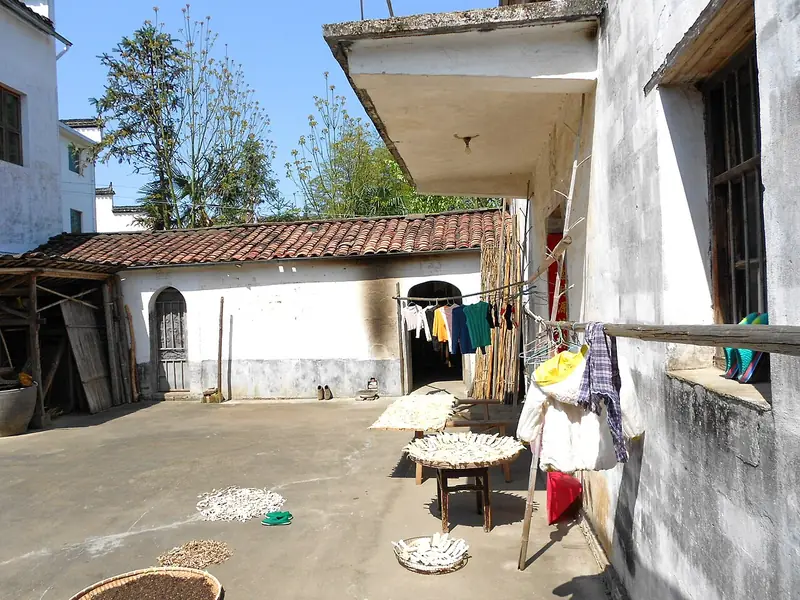
Photo adjustments
Full frame retained; EXIF orientation normalized, proportionally resized to at most 800 pixels and converted to WebP. No generated pixels or subject changes. Cards may crop the display.
Explore the region
About Sixi and Yancun Villages
Sixi and Yancun stand about half a kilometre apart, roughly 13 and 19 kilometres from the county seat at Ziyang. Sixi was founded in 1199, in the Southern Song, by the Yu family; the name refers to longing for the clear stream that runs past. For centuries men from these villages did business in Jiangxi, Zhejiang, Shanghai, Hunan and Guangxi, chiefly in timber, tea and salt, and brought the money home to buy land, put up houses and found academies. That is why an agricultural valley holds so much fine carpentry.
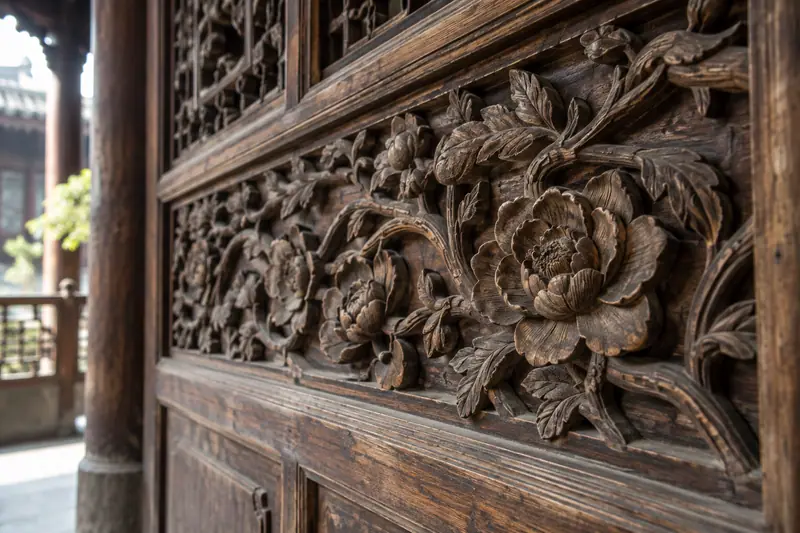
Sixi today has 172 households and 667 residents on about 8.6 hectares, with 156 old dwellings of which five are Ming and more than eighty Qing, covering some 16,000 square metres in all. Yancun has just over a hundred households and 103 dwellings, 56 of them Qing and 18 designated key protected buildings; the Jiangxi provincial government named it a historic and cultural village in July 2003. The houses are built around light wells and rise into horse-head gables with upturned eave corners, and the three Huizhou carving crafts of brick, stone and wood run through them. Yancun backs onto Huoba Hill with the Sixi river passing in front.
The two are managed together as one scenic area of five square kilometres, rated national 4A in March 2010, and the county lists their subject matter as merchant dwellings, mountain lodges and schoolrooms, winding lanes, old bridges and wells, brick, stone and wood carving, and surviving stelae. National recognition came to each village separately: Yancun was named a Chinese Historic and Cultural Village in November 2008 and a Chinese Traditional Village in December 2012, while Sixi was listed as a Chinese Traditional Village in August 2013 and named a Chinese Historic and Cultural Village in March 2014.
What to look for
- The 'hundred longevity' panel on the lattice doors of the Yu family guest house, ninety-six characters for longevity each cut in relief in a different script
- The Qing merchant houses named by the county: Zhenyuan Tang, Chengyu Tang, Chengde Tang and the Xiaoyou Jianlong hall
- The Jingxu Tang flower hall, and the Qing 'silver store' room, which the county describes as rare
- The Ming-period Tongji Bridge and the Rulaifo pillar at the village entrance, surviving parts of the traditional water-gate ensemble
- The light wells at the centre of each house and the horse-head gables with upturned corners that define the roofline
Location & getting there
Getting to Sixi and Yancun Villages
Identify the main visitor approach and any separately managed houses, museums or performances. Ask before entering residential spaces or photographing residents.
- Search for 思溪延村 with 上饶市 and 婺源县.
Find Sixi and Yancun Villages
思溪延村 · 婺源县
No reliable map pin yet: search by the Chinese name.
Sources & visit information
The linked sources support the identity and background described in this introduction. Opening hours, admission, activity availability and exact arrival arrangements have not been comprehensively checked. Confirm current visitor information with the venue; the original catalogue locality and editorial review flag are retained.