

Photo adjustments
Full frame retained; proportionally resized and converted to WebP. No retouching or changes to the photographed subject. Card displays may crop the view.
Explore the region
About Wuhu Guangji Temple
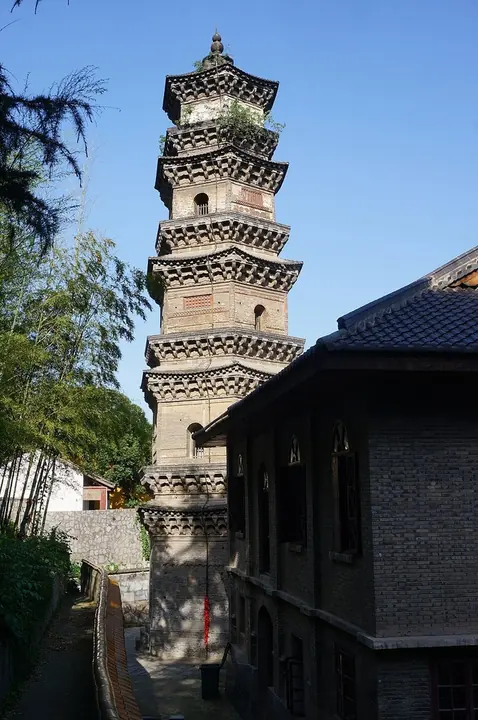
Its Zhe Pagoda preserves a Northern Song landmark, with five storeys and a six-sided plan, while Dicui Pavilion represents an early twentieth-century layer of the complex. Many of the main halls are later rebuildings. This mixture gives the visit a useful architectural sequence: look at the older pagoda, the smaller pavilion and the way the modern temple halls adapt to the hillside.
The temple was said to have been founded in the Qianning era (乾宁, 894-897) of the Tang dynasty, traditionally to commemorate the monk Jin Qiaojue (金乔觉); renamed Yongqing Temple (永清寺) in the Guanghua era (光化, 898-901), it took its present name in the Northern Song. Pilgrims to Jiuhua Mountain traditionally stopped here first to burn incense, giving it the name 'Little Jiuhua' (小九华). A fire in the Qing dynasty's Xianfeng period destroyed the temple, which was later rebuilt in the Guangxu period.
The temple's halls were rebuilt in recent decades and are arranged along a central axis in four courtyards, in a layout said to imitate Jiuhua Mountain. Dicui Pavilion (滴翠轩), which was originally named Guixuan (桧轩) and served as the study of the Song calligrapher Huang Tingjian (黄庭坚), was rebuilt in 1919 and later used to honour the god Wenchang and local worthies.
The temple holds a gold seal cast in AD 757, the second year of the Zhide era, known as the Dizang Licheng seal (地藏利成金印). The view of Zhe Pagoda in clear weather, 'Zhe Pagoda in the morning mist' (赭塔晴岚), was counted among the historic Eight Scenes of Wuhu.
What to look for
- The five-storey, hexagonal Zhe Pagoda.
- Dicui Pavilion and the stepped hillside arrangement of the temple halls.
Location & getting there
Getting to Wuhu Guangji Temple
Use Guangji Temple on the southwestern lower slope of Zheshan in Wuhu’s Jinghu District. Approach from the temple-side entrance to the hill and allow for steps between the halls and pagoda.
Combine your visit
A suggested sequence linking the specific features of this visit.
-
Main temple halls
Follow the stepped arrangement of the Buddhist precinct.
-
Dicui Pavilion
Compare the smaller early twentieth-century building with the rebuilt halls.
-
Zhe Pagoda
Finish with the surviving Song-period tower and its distinctive plan.
This order is editorial. Confirm access and any transfers between stops; it does not establish a walking route, same-day connection or common admission ticket.
Find Wuhu Guangji Temple
芜湖广济寺 · 芜湖市
The pin marks the area, not the entrance.
More places nearby
Approximate straight-line distances between map pins, not travel distances.
Zheshan 赭山
1 km awayZheshan is a small hill group in central Wuhu. Its name refers to the reddish colour of the rock and soil.
View guide →Wuhu Mirror Lake 芜湖镜湖
2 km awayWuhu’s Mirror Lake consists of two adjoining lake spaces at the edge of the central shopping streets. Yanyu Dun, a small island with a red building and literary memorials, gives the landscape a distinctive cultural focus. Its…
View guide →Wuhu Fantawild Adventure 芜湖方特欢乐世界
5 km awayThe original Fantawild Adventure park on Yinhu North Road in Wuhu. Current public ride access is unverified; confirm operation before visiting. It is separate from the later Fantawild parks elsewhere in the city.
View guide →Sources & visit information
The sources below support the place-specific description and arrival information. Suggested combinations are editorial planning ideas; confirm current opening, entry arrangements and transport services for your date.
- en.wikivoyage.org ↗
- 广济寺 (芜湖) ↗
- Chinese Wikipedia: 广济寺 (芜湖) (revision 85375194, 2024-12-19) ↗
- English Wikipedia: Guangji Temple (Wuhu) (revision 1367638474, 2026-08-04) ↗
Visitor information adapted and edited from Wikipedia contributors, “广济寺 (芜湖)” · CC BY-SA 4.0. Source revision 85375194.
Background paragraphs translated and condensed from Wikipedia contributors, "广济寺 (芜湖)", Chinese Wikipedia · CC BY-SA 4.0. Source revision 85375194.
Background paragraphs condensed from Wikipedia contributors, "Guangji Temple (Wuhu)", English Wikipedia · CC BY-SA 4.0. Source revision 1367638474.