

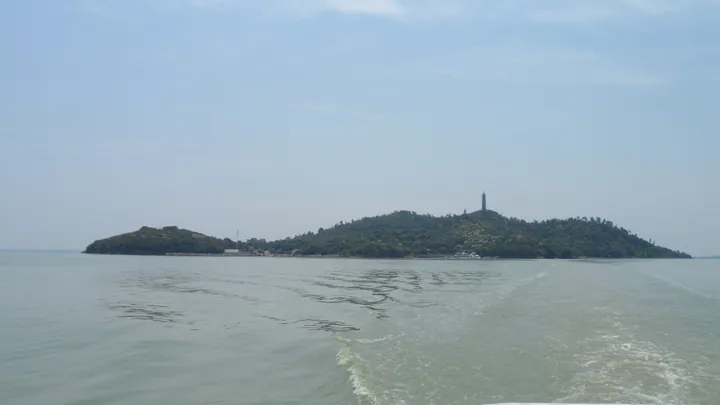
Photo adjustments
Full frame retained; proportionally resized and converted to WebP. No retouching or changes to the photographed subject. Card displays may crop the view.
Explore the region
About Laoshan Island
Laoshan Island (姥山岛) is the largest island in Chaohu Lake (巢湖), lying in the middle of the lake southwest of Zhongmiao (中庙) in Chaohu city, Hefei (合肥), Anhui. Locals also call it Mushan (母山), "Mother Mountain".
The island covers 0.86 square kilometres and rises to 115 metres. It is an old volcanic island, formed more than 200 million years ago, with three hills and nine peaks under evergreen woods of pine and bamboo. The island has more than twenty caves; the largest can hold over a hundred people. The island is tied to the local legend of the sinking of Chaozhou (陷巢州), told in the Soushen Ji (搜神记): an old woman surnamed Jiao (焦) who warned her neighbours of a flood was drowned and became the island, while the flooded city became the lake. Two rocky islets nearby are said to be her lost shoes, and Gushan Island (姑山岛) further out is said to be her daughter.
The seven-storey, octagonal Wenfeng Pagoda (文峰塔) on the summit is built of stone blocks and stands 51 metres tall, with 135 steps. Work began in 1631, when the Luzhou (庐州) prefect Yan Ergui (严尔珪) proposed it in answer to a local saying that Hefei would produce no top examination graduate while the island lacked a peak; three storeys were finished before war stopped the work. In 1878 Li Hongzhang (李鸿章) revived the project, and Wu Yufen (吴毓芬), whom he sent to supervise, added four more storeys. Li then invited Huai Army (淮军) commanders and officials to write inscriptions, so the interior holds 25 inscribed plaques, including Li's "文光射斗" (literary light shooting to the stars) and Liu Mingchuan's (刘铭传) "中流一柱" (a pillar in midstream), along with 802 brick-carved Buddha figures. The pagoda became an Anhui provincial protected site in 1998 and a national one, in the eighth batch, in 2019.
Halfway up the hill, Shengfei Temple (圣妃庙) faces the lake. It honours the goddess of the lake and was first built in the Jin dynasty; poems on it by the Tang poet Luo Yin (罗隐) and the Song lyricist Jiang Kui (姜夔) are carved on its pillars. At the southern foot is a natural sheltered harbour once called Nantang (南塘), built at the end of the Yuan dynasty by the naval commanders Yu Tonghai (俞通海) and Liao Yong'an (廖永安), who camped their fleet on the island.
What to look for
- Wenfeng Pagoda (文峰塔), a 51 m, seven-storey stone pagoda begun in 1631 and finished in 1878, with 25 inscribed plaques by Li Hongzhang and Huai Army commanders and 802 brick-carved Buddhas
- The view over Chaohu Lake from the top of Wenfeng Pagoda
- Shengfei Temple (圣妃庙), a lake-goddess temple first built in the Jin dynasty, with poems by Luo Yin and Jiang Kui carved on its pillars
- Nantang (南塘), a natural harbour at the southern foot built by late-Yuan naval commanders
- The three hilltop pavilions Wanggu (望姑), Hushang (虎上) and Wanglao (望姥)
- Caves in the island's slopes, the largest big enough for a hundred people
Location & getting there
Getting to Laoshan Island
- Search for 姥山岛 with 合肥市 and 巢湖市.
Find Laoshan Island
姥山岛 · 巢湖市
No reliable map pin yet: search by the Chinese name.
Sources & visit information
Written from the linked sources and checked sentence by sentence against quoted extracts by a separate reviewer on 2026-09-23. Opening hours, admission and access arrangements are not covered; confirm current visitor information with the site.
Some facts checked against Wikipedia contributors, "姥山塔" · CC BY-SA 4.0.
Some facts checked against Wikipedia contributors, "姥山岛" · CC BY-SA 4.0.