

Photo adjustments
Full frame retained; EXIF orientation normalized, proportionally resized to at most 800 pixels and converted to WebP. No generated pixels or subject changes. Cards may crop the display.
Explore the region
About Yinping Mountain
Yinping Mountain (银屏山) is the highest peak in Chaohu (巢湖市), Hefei (合肥), Anhui, at 508 metres, rising on the south side of Chaohu Lake (巢湖); it is known for a single wild white peony growing out of a cliff.
Two stories explain the name, which means 'silver screen': one points to a large silvery-white boulder on the mountain, the other to its south-facing cliff, sealed in snow and ice in deep winter. The slopes are more than 90 percent forested, and the mountain is strewn with oddly shaped rocks known as Chaohu stone (巢湖石), similar to Taihu stone and sometimes holding fossils of sea creatures. The operator runs the mountain as a national AAA scenic area and the core of the Chaohu national scenic area.
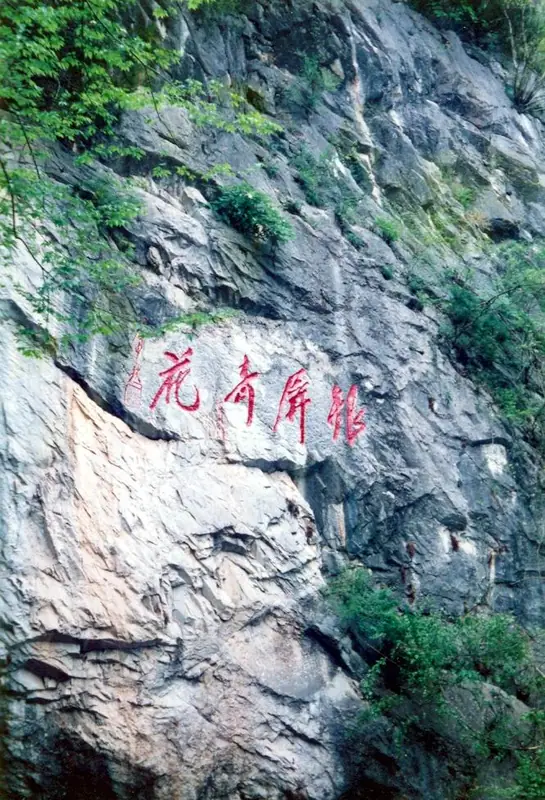
The Yinping peony (银屏牡丹) grows from a rock crack about 30 metres up a cliff. The Chaohu county gazetteer gives it more than 1,300 years, and the operator says it has been written about since the Tang dynasty; a poem by the Northern Song writer Ouyang Xiu (欧阳修), 'Viewing Flowers at Xianren Cave' (仙人洞看花), is cited as evidence of its age. It flowers around Guyu (谷雨, 'Grain Rain') in April, and locals read the year's weather from it: few, early flowers foretell drought, many late ones flood. The gazetteer records that in 1976 the buds never opened. The plant is a Hefei municipal protected cultural relic. Below it are four characters, 'Yinping Qihua' (银屏奇花, 'the wondrous flower of Yinping'), written in 1980 by Zhang Kaifan (张恺帆), then a secretary of the Anhui provincial Party committee, and cut into the rock in 1985.
Beneath the peony, Xianren Cave (仙人洞, 'Immortal's Cave') is a karst cave about 1,200 metres long with a 30-metre vertical range, split into a spacious, bright 'white cave' and a winding 'black cave', with stalactites throughout. Legend says a Tang-dynasty man, Cui Ziran (崔自然), became an immortal inside. During the War of Resistance against Japan the New Fourth Army's 7th Division ran an underground arsenal in the cave.
What to look for
- The Yinping peony, a wild white peony in a cliff crack about 30 metres above the ground, with the 1985 rock inscription below
- Xianren Cave (仙人洞), a 1,200-metre karst cave used as a New Fourth Army arsenal
- Peony Pavilion (牡丹亭), a three-storey, 27-metre octagonal Huizhou-style pavilion on the summit, painted with 186 peonies, looking north to Chaohu Lake and south to the Yangtze
- Longxing Temple (龙兴寺), called the 'little Jiuhua north of the river' (江北小九华)
- Lovers' Nanmu (情侣楠), a facing pair of wild Phoebe trees
- The 'miniature stone forest' (微缩石林) of dark grey Chaohu stone pinnacles
Location & getting there
Getting to Yinping Mountain
- Search for 银屏山 with 合肥市 and 巢湖市.

Find Yinping Mountain
银屏山 · 巢湖市
No reliable map pin yet: search by the Chinese name.
Sources & visit information
Written from the linked sources and checked sentence by sentence against quoted extracts by a separate reviewer on 2026-09-23. Opening hours, admission and access arrangements are not covered; confirm current visitor information with the site.
Some facts checked against Wikipedia contributors, "银屏山" · CC BY-SA 4.0.