

Photo adjustments
Proportionally resized and converted to WebP without cropping, retouching or changing the photographed subject.
Explore the region
About Ancient Observatory
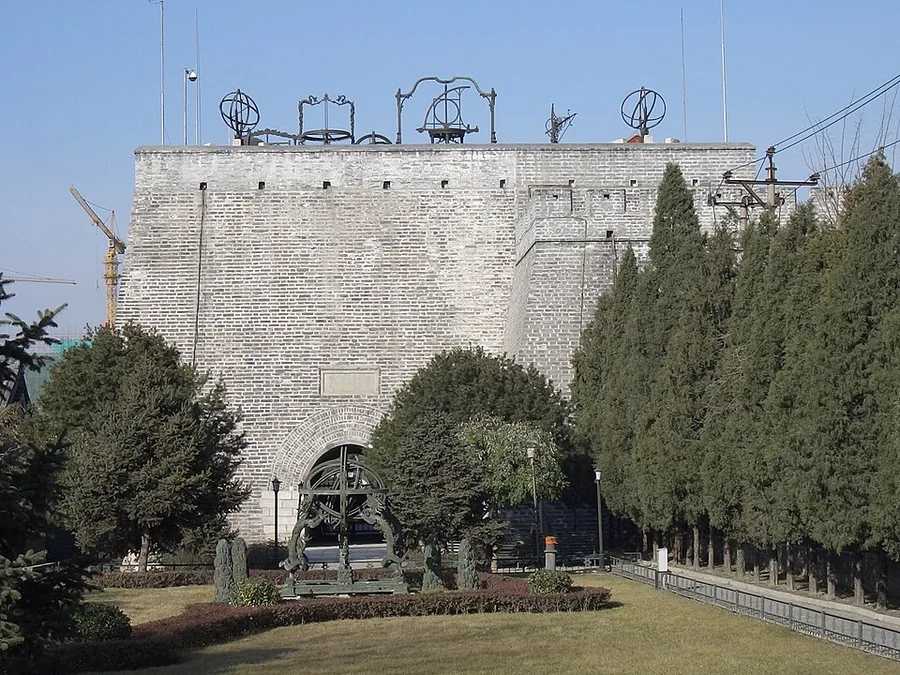
The raised terrace carries large instruments for observing the sky, while the museum displays explain the history of Chinese astronomy through star maps and related material. The contrast between precise scientific apparatus and the defensive-looking brick platform is the site’s distinctive feature. Read the indoor interpretation before examining the terrace instruments so that their forms mean more than elaborate metalwork; access to the upper platform should be checked as part of the visit.
The observatory was built in 1442, during the Ming dynasty's Zhengtong era (正统), on the site of the old southeast corner tower of Yuan-dynasty Dadu (元大都). Its castle-style platform was extended eastward twice under the Qing, and the bronze instruments on it were replaced several times during the Ming and Qing dynasties.
All the instruments were seized in 1900 and returned in 1921. The platform is faced in grey brick and rises 14 meters, measuring 24 meters east-west and 20 meters north-south; a set of large bronze instruments from the Qing dynasty stands on its south, west, and north sides, including an equatorial theodolite (赤道经纬仪) and a celestial globe (天体仪).
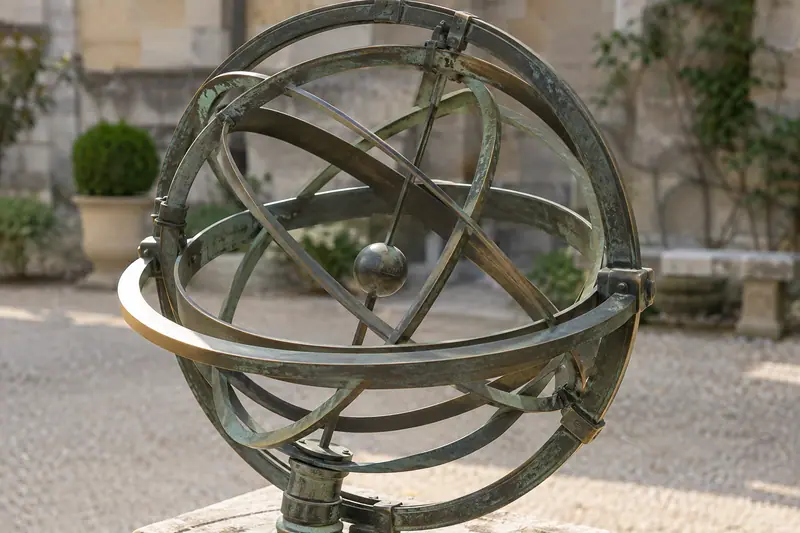
A courtyard (四合院) west of the platform holds the Ziwei Hall (紫微殿), a three-bay main hall with a grey-tiled roof, flanked by two side halls; a Ming-dynasty armillary sphere (浑仪) and simplified instrument (简仪) stand beside it. After 1956 the site was for a time open as a museum, then used as offices from 1959 before reopening as a museum in 1983. It was listed as a Major Historical and Cultural Site Protected at the National Level (全国重点文物保护单位) in 1982.
What to look for
- Terrace instruments: compare the shapes of the large astronomical devices above the former wall platform.
- Star maps and astronomy displays: use the interpretation to understand what the instruments were designed to measure.
Location & getting there
Getting to Ancient Observatory
The matched listing gives No. 2 Dongbiaobei Hutong, at the southwest corner of Jianguomen Bridge, with Jianguomen station on Lines 1 and 2 nearby.
- Approach the observatory’s public entrance through the local streets; the surrounding road interchange is not a direct pedestrian route to the terrace.
Combine your visit
Suggested order within this visit:
-
Astronomy displays
Begin with the observational history and star maps.
-
Instrument terrace
Connect that explanation with the large devices on the platform.
-
Brick-platform exterior
Finish by reading the observatory’s relationship to the old city wall.
This sequence is an editorial suggestion based on the features described in the sources. Access to individual buildings or areas should be checked locally; no travel time or shared admission is implied.
Find Ancient Observatory
北京古观象台 · 东城区
The pin marks the area, not the entrance.
More places nearby
Approximate straight-line distances between map pins, not travel distances.
Ming City Wall Relics Park明城墙遗址公园
Less than 1 km awayMing City Wall Relics Park follows a surviving stretch of Beijing’s former inner-city wall from the Chongwenmen side toward Dongbianmen. Its brick ramparts and Southeast Corner Tower show how the walled city was defended before…
View guide →Ritan Park日坛公园
1 km awayRitan Park surrounds the former Temple of the Sun in the modern Chaoyang district. The historic altar recalls the imperial ceremonies once held here, while the surrounding public garden now sits among central Beijing’s offices…
View guide →Shijia Hutong Museum史家胡同博物馆
2 km awayShijia Hutong Museum places the story of a Beijing lane inside a traditional courtyard residence on that same street. The setting lets visitors relate exhibitions about neighborhood history and residents’ daily lives to the…
View guide →Sources & visit information
The sources below support the place-specific description and arrival information. Suggested combinations are editorial planning ideas; confirm current opening, entry arrangements and transport services for your date.
Visitor information adapted and edited from Wikivoyage contributors · CC BY-SA 4.0.
Background paragraphs translated and condensed from Wikipedia contributors, "北京古观象台", Chinese Wikipedia · CC BY-SA 4.0. Source revision 93738957.